Showing posts with label travel stress. Show all posts

Tuesday, January 29, 2013

Onward and forward to Home


Things were getting tense in the apartment in Amsterdam: my roommate turned good friend, Lara, had been searching for a new room with mounting pressure; the landlord figure of the apartment was flip-flopping his opinion of us daily; my short-term room rental was coming up anyway. The internship I had arranged with IISH before I left California had been put on hold due to troubles on their part to obtain a work permit, and by extension, a residence permit for me. Winter was closing in on Amsterdam; I would put on all the clothes I owned before going outdoors (long johns, pants, an under shirt, a long-sleeve backpackers top, two wool sweaters, two scarves, wool socks, a jacket, and fleece gloves) and was almost warm enough. The days were growing shorter and the temperature lower as I grappled with how to pass a dark, cold winter mostly alone.

My routine in Amsterdam primarily revolved around staying sane, which is to say I came up with arbitrary tasks for myself to give structure to my days. This roughly equated to switching off making dinner with Lara, cycling to the library to write and do any necessary research, catching the open nights of the local museums, wandering Borneo Eiland, and spending a lot of time online, trying to avoid dwelling on the fact I was alone, needed to again find a room to rent, and that my tourist visa was about to expire.

One afternoon Facebook flooded with the news an important friend from my High School years had died. I was in shock. No one even knew Jeremiah was missing, or that he had been missing for almost 2 years, or that deer hunters had come across human bones on his parents’ property in Big Tujunga Canyon, or that authorities were DNA-testing the remains that had been found.

All of a sudden everything came together. The call was undeniable. I booked a ticket on a Saturday to fly back to California on the following Monday. Besides, the holidays were nearing.

It’s funny to think about it now: all the packing and freaking out I did back in July, thinking I would be gone for a whole year; the day I ran up and down Avenida Sante Fe in Buenos Aires, referring to my pack as all my possessions for a year; the same two pairs of pants I wore every day and my refusal to buy souvenirs in Dakar, maintaining I would have to carry them with me everywhere for a year. Somehow I had come to regard a return to California before a year had passed to be a failure, or a sign of weakness.

Lara and I talked about this as we waited for the bus in her new neighborhood in Amsterdam. Night had fallen and Dutch teenagers were zipping by on bikes, off to whatever Saturday night held for them, while cars and trucks drew the long gaze of their headlights over the bus shelter. Lara had finally found a great room and we were in the middle of moving her stuff to the new place and had the left overs of the enchilada pie I made the night before—a family recipe of Americanized-Mexican food—to look forward to for dinner. “This is what you need to do now, and it’s not failure,” she was saying in her Lithuanian accent. “A friend of yours died and you want to remember him.” I nodded and also thought of my mom and my dad, and how much they had worried about me and missed me.


When I did see my mom after returning to California, I surprised her and she cried real tears of joy. I’ve seen my mom laugh so hard she’s cried, I’ve seen her cry from extreme mourning, and I’ve seen her cry from pain, but I’ve never seen her cry tears of joy. At that moment the concept of home firmly installed itself into my notions of family—I thought to myself, without the least hint of bitterness, that home was wherever my mom and I were together.

Lara and I often talked about home and what drew us from our respective homes to Amsterdam. We both have some gene that compels us to leave home despite the pain and uncomfortable feelings it causes because the alternative—wondering what could have been—is not an option. In the stress of again needing to find a place to live—the high cost of housing and super-competitive housing market in Amsterdam tends to churn out crazy landlords and insufferable roommates—she would often toss around the idea of going back to Lithuania. In better, more optimistic moments, she would return to her lone-wolf determination, and we would gush about the beauty of Amsterdam’s tree-lined canals in early winter, when the last of the crispy leaves fell on the water and obscured the bike paths. Lara’s own frequent change of heart regarding her home reflected mine, yet ultimately it was up to us to bring “home” with us wherever we went. Home is not a place you left and it is not the place you’re at; it’s something you must guard inside of yourself, readying it to share with the good people around you, no matter what country, city, or cargo ship you’re in.   

In this part of the story, Lara’s struggles resulted in her finding a new room in a great apartment—and by extension, a place to bring her own home—while my struggles resulted in me bringing my home back to the place I came from. For me, this created a composite image of memories spanning childhood to my life as a young professional overlaid onto the new open-minded perspective I’d developed while crossing the Atlantic on a freighter. Never before had the image of home seemed so multi-faceted, so nostalgic, and so translucent.

When I arrived at the airport in California, I was delirious with the pleasure of understanding the signs and being able to speak American English with native speakers. I actually exclaimed, “Thank you! It’s so great to speak English! I’m in California!” to the airport worker who directed me to the exit. Although Christmas was still some days away, every morning felt like Christmas morning for about a week. Walking outside in the 65 degree sunshine, taking a hike in the hills or just a stroll to the bus stop brought out a hardy, “California weather is a panacea for all that ails me!”

I made arrangements to go to Jeremiah’s memorial with Christie, one of my best friends from High School. We got in her forest green Civic and began the familiar trip up Angeles Crest. Here, the familiar curve of Oro Vista that showcases the looming texture and rockiness of Big Tujunga Canyon’s ridges; here, the fork in the driveway that leads up to my great aunt’s former property; here, the first bridge that crosses over the wash. Finally, the exit into Rancho Ybarra, where Jeremiah grew up and where his family runs a Christian camp. The familiar descent past the house (those funny memories of “caking” Jeremiah’s car senior year), down past the swimming pool (where us girls tried to get the guys to skinny dip one summer night), and into the parking lot by the dorms and auditorium. We got out of the car and started towards the folks milling around, one of which was Jason, another good friend from High School and Jeremiah’s best friend. I stopped Christie short of meeting Jason and pulled her in for a big hug while I staved off tears. “I love you, I am so glad we’re here together,” I said to her.

The service was a bit typical, considering we all went to a private Christian High School and that Jeremiah’s parents run a Christian camp. Worship songs, sharing of memories, a sermon, and an altar call. After the service Christie and I slowly made our way through the groups of people eating and chatting. We ran into old teachers, parents of old friends, and even some old friends themselves. We shared stories of deaths, injuries, marriages, and babies. We gravitated towards Jason, and once everyone we needed to talk to had left, the three of us drove to the Big Tujunga Canyon Dam and Reservoir up the road. A heavy mist floated through the canyon and in turn coated the usually dry mountains, rendering them a brilliant ruddy color that popped behind the dark California chaparral. It was all so striking and I had trouble reconciling the fact I once considered this beauty commonplace while at the same time it occurred to me, in total, as home. I grew up here, I come from here, kept going through my mind. We shivered as the sun sat and the mist grew thicker, yet we lingered, sharing stories and reminiscing about all we discovered in each other’s—and Jeremiah’s—presence.


After that day I couldn’t help but conflate the concept of home with the physical traits of the place from which I come. I’m from the place where the great metropolitan sprawl of Los Angeles butts against the natural container of Angeles Crest, whose mountain faces radiate a deep purple when the setting sun lowers itself to eye-level. What does it say about me that only now, at 29, and after going half way around the world and back could I appreciate my hometown’s roads petering out into hiking trails and unclear property lines?

It’s been said that once you leave home you can never go back, which is to say the home you leave is never the same home to which you return. One reason is the changes you undergo internally—that whole subjectivity thing. Another reason is that you’ve made a new home in the absence of your original home, so to go “home,” you must leave “home.” What is home if you must leave it to find it? I suppose people like Lara and me make our life work out of unraveling that riddle.  

I lamented this to another of my best friends, Greg, at Christmas time. We were smoking a cigarette on the back porch of his great uncle’s house in Studio City. At 8:30 pm the temperature had dropped to 42 degrees and we were shivering. We watched the moisture of our breath condense into arabesques in the black air as I recounted my take on being back at my dad’s house, the house in which I grew up: while being there was the most comfortable I had been since I left San Francisco back in July, I approached the situation completely differently than I had on any other holiday visit. For the first time, I regarded my dad as more of a roommate and his house as more of a rental. I washed my dishes and put them away after each meal; I bought a pack of toilet paper when I used the last roll; I used my own groceries when I cooked and felt strange looting my dad’s chocolate box at night. I said to Greg, “I think part of my problem is that I feel homeless. I go from place to place, trying to carve out a niche in someone else’s space, but it always feels like I’m in someone else’s space, playing by their rules.” Only now was I realizing how deep an effect the weird situation in the apartment in Amsterdam had had on me. Greg said, with all the simplicity of a friend, “You have a home wherever you go, at your dad’s down here or up with your mom in San Francisco.” I remembered my return to Amsterdam in summer of 2011, the first time since I had studied there, and how it felt like home; I also remembered whenever I was in San Francisco and about to visit down south, I would refer to it as “going home for the holidays,” but when the time finally came to go back to San Francisco, I would say, “I’m going home.”

For the first time I thought, maybe the problem isn’t being homeless, it’s having too many homes. But now I see the problem was in the deficiency of the “home” I was—or wasn’t—carrying around with me.

In my more lonely moments, I would liken myself to Vincent Van Gogh, who spent most of his early years running from his parents and siblings, all of whom he felt didn’t accept him, in search of surrogate families away from where he grew up in The Netherlands. But now I saw it differently: one thing that made my long, circuitous trip to Amsterdam so special was the families I made wherever I went: Nestor and Julia in Argentina; the Italians and Mikhail on the ship; Bahar and her family in Belgium. I didn’t need to feel alienated from my own family to receive this blessing of making families out of friends and strangers.


Family became central to my visit, a concept defined not by blood but by kinship (after all, I am an only child). I celebrated my grandma's 94th birthday with her, I searched out one of my favorite cousins and spent Christmas with her kids, gladly invited my Uncle and his wife to Christmas Eve dinner (Chinese food!), met my dad’s girlfriend’s daughter for the first time, met up with my best friend from kindergarten, and spent New Year’s with my mom’s best friend’s daughter, making collages and getting up early for the Rose Parade. Reconnecting with these significant people, with whom I have a shared history and lineage of life, became important for my development of the “home” I carry with me wherever I go.

This part of the story is about the family I reconnected with over the holidays; it’s about the families I encountered while away from my home state; it’s about the homes I made during my unusual methods of travel. Above all this story is about what has been changing in me. In the past, my periods away from home never seemed long enough, and no matter how eventful they were, it was never enough. It was easy to routinely leave my friends and family when I was in my late teens and early to mid-twenties. But something changed this time. This was my personal version of becoming an adult, that age at which sentimentality creeps in through the cracks of freedom and independence. I did not check my apprehension and sadness I felt after saying good bye to my parents and my loved ones with my bags at the airport; I carried it around the whole time.

I’d be lying if I said I’m not nervous about going back to Amsterdam in a couple weeks. I’m nervous about the loneliness, I’m nervous about figuring out the internship situation, I’m nervous about finishing the novel and poetry chapbook I’ve started. Above all, I am nervous about the challenge of bringing “home” with me to another new apartment and making it into a home. But I also know that this “trip,” as I so simple-mindedly refer to it, is not over, and there is much to look forward to, including my return to California next summer.


Friday, November 2, 2012

The Grande Buenos Aires: The Last Days

The Grande Buenos Aires makes it way through the North Sea.

First came Emden. That tiny blip of neatly parked white cars and wind turbines towering across the horizon. Several crew members had disembarked and new faces started appearing in the hallways and on the decks. Faces of Italians and Indians I hadn’t just shared a life-transforming month with. The Germans’ disposition shifted and a bit after midnight on September 14 they drove their RV off the ro/ro ramp and out of the Grande Buenos Aires—earlier that night at dinner I had produced a bottle of California Pinot Noir (acquired back in Tilbury) for a toast to our camaraderie as the sole passengers. Even Peter who never drank had half a glass.

One of the last meals I shared with the Germans.
The majority of cargo in the Port of Emden, Germany seemed to be Audi automobiles, all wrapped in white protective coating.

Wind energy is big in North Europe. The new passengers told me it's bad for the sealife, though.
I don't know if they're right but I agreed with them anyway.

Early the next afternoon the ship was pulling out of the port. I hadn’t touched land.

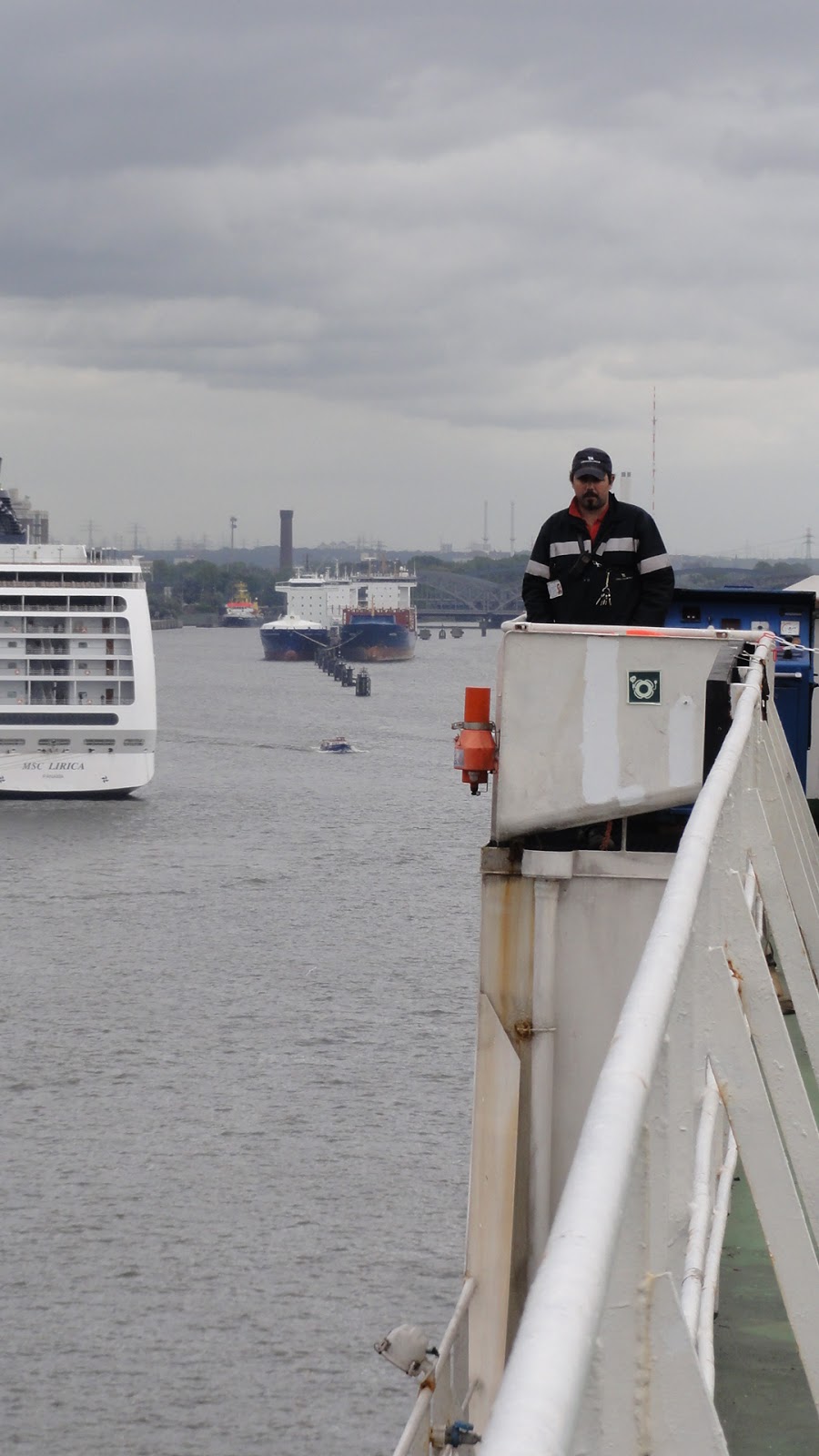
Then came Hamburg. The trip up the river was long and scenic and I passed most of the day taking pictures on the deck even though I was shitting my pants: my spirit cruise was coming to an end in two or three days and I had lost track of time, thinking I had four or five days. The big bad world daunted me; all decisions had been made for me for the past 32 days; all meals prepared and fed to me; all bedding and towels washed and replaced. What was I going to do without my ship peeps, without this floating group home that moved at 18 knots and had a dead weight of 26,169 tons, without the structure and predictability of its routine?

It appeared as though many local Germans were taking advantage
of the early September mild weather by going for a sail in the Elbe river.
Some scenery coming up the Elbe river.
Notice Chief Cook Marcelo taking some pictures from the deck on the right.
The beginning of the river banks hosted more rural developments.
The industrial area of the port looms.
The Captain and the local pilots at work.

There was much evidence of nautical tourism and passenger ships near the city center.

Yours truly, wearing the stocking cap I got from the Seafarer's Centre in Tilbury.

Colorful facades inhabited the banks of the river Elbe nearer the center of Hamburg.

Many church steeples dotted the horizon, mixed with other towers and construction cranes.

This was a modern building being constructed on the water. It was interesting to see Hamburg's prosperity illustrated in the many construction cranes and mix of old and new architecture. 

The Chief Mate in position on the other side of the bridge.

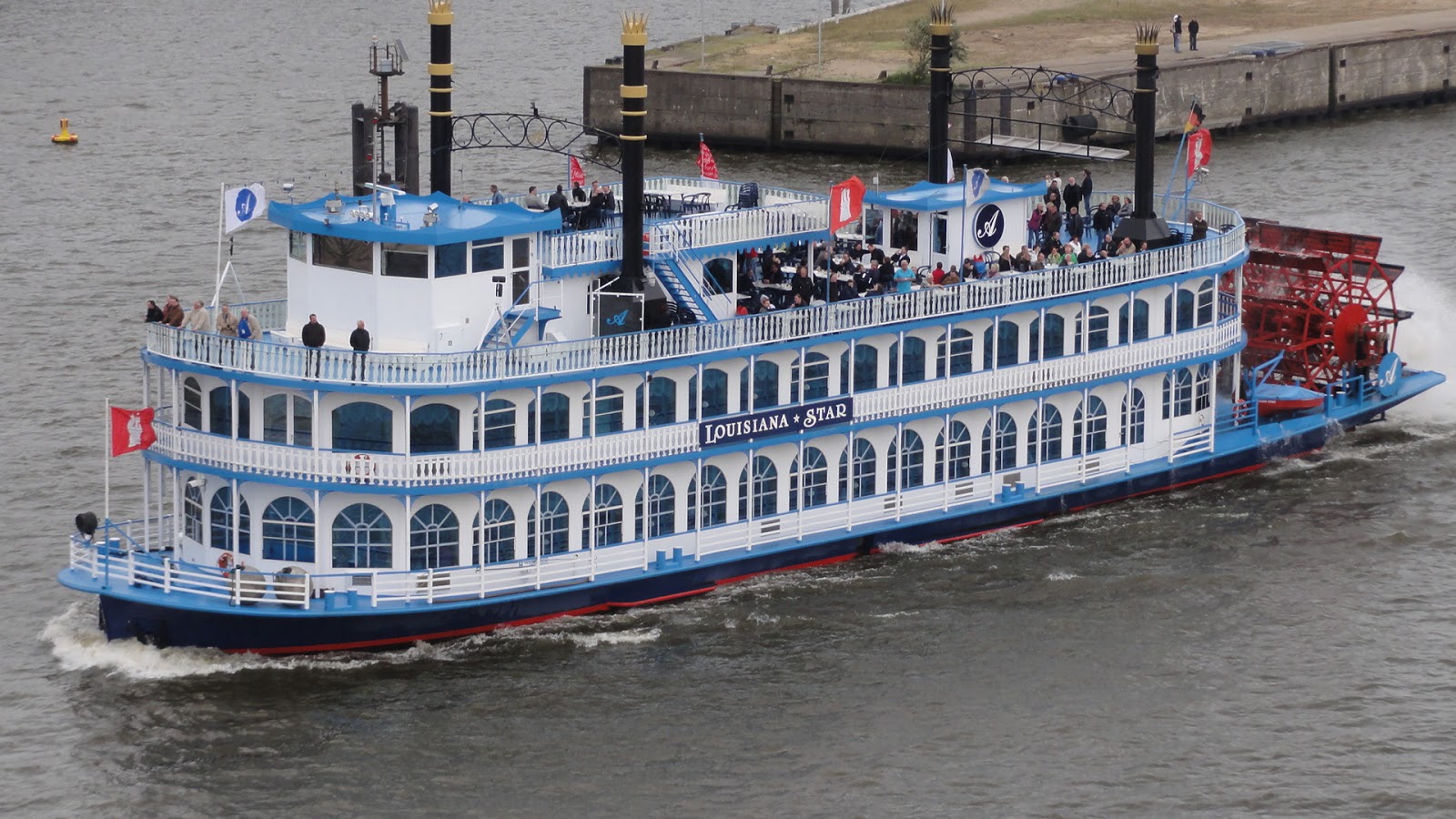
A little bit of good ol' America in Hamburg. The Louisiana Star!

 Well, if I had to disembark, we were going to go out in style. On Friday, September 14 Mikhail and I walked down the ro/ro hatch, got the port shuttle to the gates, and called a taxi. We got dropped off on St Pauli, which is basically Germany’s version of Vegas I soon realized: the streets teemed with regional Germans who had come to drink, gamble, ogle naked ladies, and hook up with prostitutes, the latter of which were neatly dressed and made up girls that lined the street corners with crisp black fanny packs strapped around their hips. (What a juxtaposition to the prostitutes of the Manila Discotee back in Vitoria, Brazil!) We had a few drinks at the 24 Carat Cocktail Bar, checked our email, walked around, ran into Marcelo and Filipo chowing down on doner kebab, and eventually became overwhelmed by the tourists looking for their weekend thrills before their looming weddings (Hamburg is the place for bachelor parties). Mikhail bought me a bouquet of roses from a street vendor, which was sweet: I love flowers and had wanted some in my cabin ever since I beheld the florist section of the Asda supermarket in Tilbury.

Checking our email and having a drink in the 24 Carat Cocktail Bar in Hamburg.

One side street comprised of adult entertainment businesses. There were so many people on the streets!

Party down, haha.
 A few short hours later, we decided to grab a cab and head back to the ship, but not without a bottle of Jameson, special request for the little lady! Our cab driver was a young Turk who spoke English well, so we told him our stories while we traversed the entire international shipping zone of Hamburg looking for a night shop that had Jameson. A few tries in, I settled for Valentine’s and we were finally deposited back at Terminal O’Swaldkai. We went to the galley, cut off the top of a water bottle, and plunged the peach roses into the warm sugar water I had concocted.

Oh dang, there goes one more day on the Grande Buenos Aires.

Our cab driver with the bottle of coveted whiskey. Disclaimer: I, a passenger of the Grande Buenos Aires, drank this whole bottle and didn't share with any crew :-P

Back on the ship, with my roses in the cut-off water bottle masquerading as a vase.

The next day the first wave of new passengers embarked: a couple of Dutch/Germans who were starting a two-year tour of South America that they had been dreaming of for 45 years. The remaining 10 passengers would board in Le Havre, long after I had disembarked. At dinner I began to pass my knowledge onto them as my previous fellow passengers had done when I embarked in Zarate all those days ago. What the meals usually consisted of, how much wine came with the meals, who ate where, how to send an email via satellite, the schedule of the steward (Mikhail)… but, I found myself losing patience with their wide-eyed sense of discovery, their lamentations they missed their dog, their disappointment the ship didn’t have wifi. This ship will change your life if you let it I almost wanted to shout at them.

Some of the cargo in the port included this public transit metro car, which looked pretty out of place among the construction equipment waiting to be loaded. 

The ship docked behind ours.

My Top Shop blouse flutters beautifully and forlornly in my cabin window while Hamburg passes outside.

Coming up the river to the Port of Antwerp on Monday, September 17 was bittersweet: it’s Belgium! It’s Antwerp! It’s the port! My two worlds collided: the first time I left the United States and my culture bubble burst was over 12 years ago and Antwerp, Belgium was the scene of the crime. That trip with my High School exchange program had transformed the way I looked at the world and had ignited my life-long obsession with travel and Europe. I remember being amazed at the smallest things, like how Diet Coke was Coca-Cola Light and how you had to pay to use a public restroom and how common fragrances like hand soap and deodorant just smelled different. Now, perhaps the one most perception-shifting travel experience since then, the Grande Buenos Aires, was going head-to-head with Belgium literally and figuratively. Who would win? I didn’t even want to take bets—I was still in denial I would be disembarking and maintained my desire to stay on the ship forever.

Back to sailing through the North Sea.

Entering into the port area of Antwerp, Belgium.

We were cruising next to this other cargo ship for a while.

Cargo cranes stand ready and at attention. 

The cadet raises the Belgian flag.

Traffic lanes in the Schelde river.

We waited in the lock next to this building for a while, and I caught the reflection of the ship's insignia in the reflective windows. Little did I know this would be the scene of immigration control when I left the port the next day. 

Waiting in the lock from the river to Grimaldi area of the port.
I ended up getting one extra night: we docked around 21:00 and I made arrangements to disembark the next morning at 10. I spent the night organizing my things, throwing away unneeded papers and brochures, consolidating toiletries, and did one last load of laundry. Slowly my little space transformed back into the generic cabin that all passengers encounter upon embarking. I kept going outside to watch a good chunk of the crew unload a truck of kitchen supplies, including crates and crates of bottled water, which were hoisted up to deck 12 and moved into the galley. Supplies I would never partake of.

I reluctantly left The Consoled by Kazuo Ishiguro, which I found in the ship's library, on the ship despite it being a beautiful hardback edition and despite the fact it was the best book I'd read in a long time. 
The ship's pantry shortly before restocking. Notice the crates of bottled water on the left.

Telltale signs of Italian and Indian fare: cans and cans of tomato sauce and bags and bags of  basmati rice.

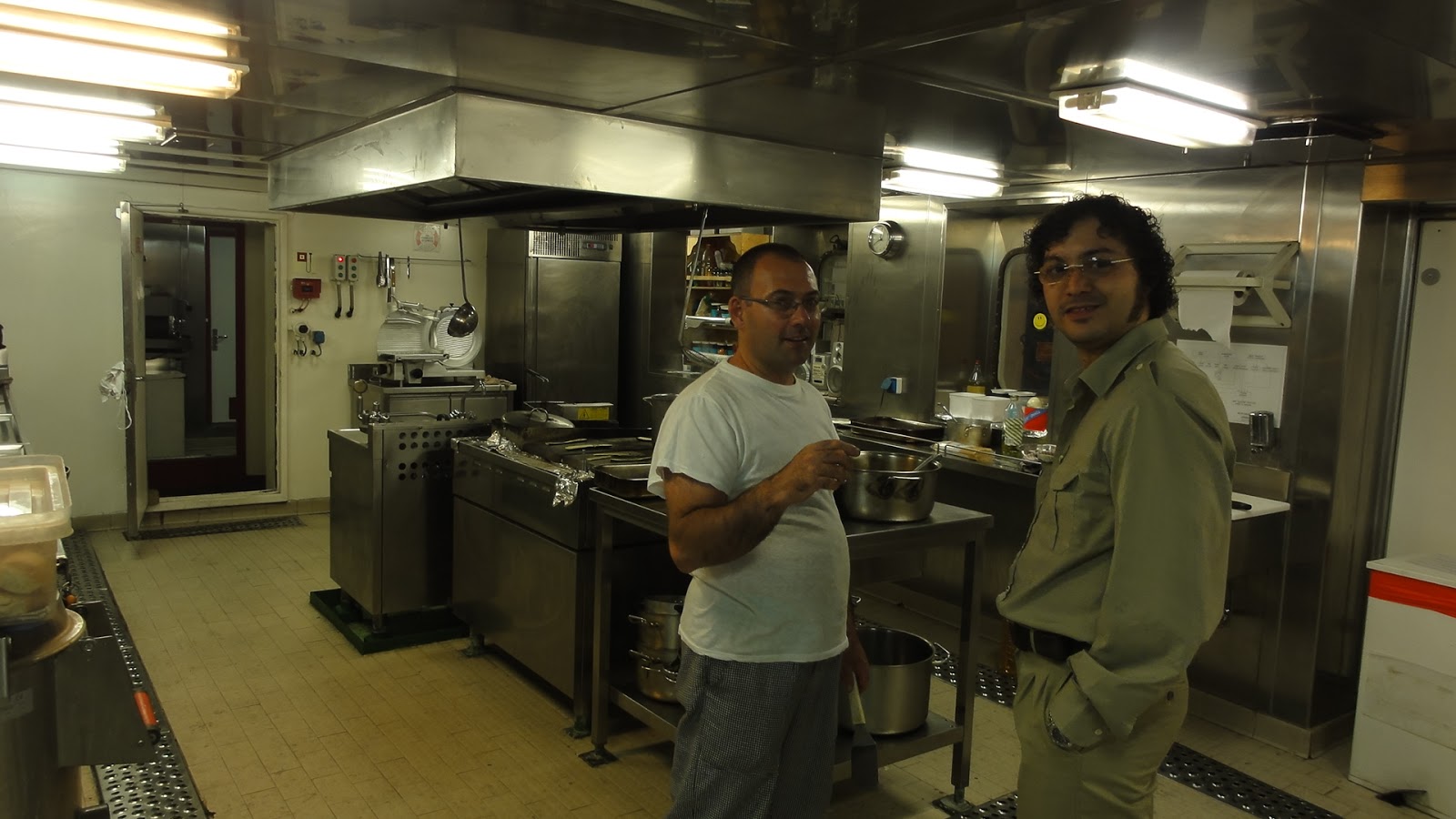
Chief cook Marcelo and Engine Officer Filipo in the galley. Filipo liked Marcelo because he made good Sicilian dishes and Filipo was obsessed with being Sicilian. 

The sunrise on September 18 was insanely ablaze; a bold red streaked through the morning thundercaps above the cranes of the port. Meanwhile, on the other side of the ship, it started raining and a brilliant rainbow pierced the grey sky. I tried to eat breakfast but could barely muster it; I was nervous about going into Antwerp and trying to find my friend Bahar, a holdover from the Belgian Exchange period who I hadn’t seen in 8 years. I was also really sad and was trying not to think about it. Nonetheless, Mikhail brought me a stock of wrapped sandwiches the Chief Cook Marcelo had whipped up. Whatever happened, I wouldn’t immediately starve upon disembarkation.

Amazing, yet ominous, red sunrise in the Port of Antwerp.
Red sky at night, sailors' delight.
Red sky in the morning, sailors heed the warning.
My dad taught me that one when I was young.
I went back to my cabin and finished packing up my backpack, trying to account for every possible scenario. Rain? Cold? Warm? Pleasant? I wrapped my shoes in a trash bag before inserting them into the netted pocket on the side of my back pack. I put the Sellotape I had purchased in Tilbury in my bag at the last moment—never know when you’ll need to tack up a map or poster to a barren wall. Everything empty, except the peach roses in the cut-off water bottle on the dresser that continued to open to a full bloom.

My bouquet sits by its lonesome on my dresser.

Bye bye familiar corridor. 
A few minutes before 10, Mikhail arrived at my cabin, picked up my bag, and we took the elevator down to deck 3, where I walked off the ro/ro hatch one last time. Crescenzo, the Chief Mate, Shona, Miguel, and some others were down there. Trying to keep my composure, I kissed each of them good-bye then we headed to my waiting taxi. Smiling, Mikhail said, “Have fun in Amsterdam, don’t drink too much, don’t smoke too much, be good,” and slammed the door shut. My eyes watering, watering, but I told myself: hold it together, you gotta go through immigration control, you gotta go to the city center, you gotta find Bahar.

And I did, I did do all those things, and I didn’t even cry. 

Friday, August 10, 2012

Buenos Aires, Argentina Part 2

Buenos Aires was a shock to the system. I found myself avoiding going out doors to the point that I've lost a significant amount of weight from not maintaining my normal eating habits. When I finally did take a breath and cross the threshold, I would roam for miles (or, should I say kilometers) down what I considered secure corridors without ever going inside a cafe, restaurant, or shop. Picture me walking for 4-5 hours while constantly trying to ascertain if the street is safe, if there are women and children on the sidewalk, if the men are old or young. (I partially blame the countless "be safe!" tidings bestowed on me; while well-meaning and technically good advice, they tend to promote a paranoia that makes it hard to for me to enjoy myself.)

Self portrait in double reflection: the balcony window and the mirror
above the dining room table in the first apartment I stayed in.
Speaking to people terrified me because people in this region speak Rioplatenese Spanish, the sound of which I can best describe as Spanish with the inflection of Italian and the suaveness of French. The double L, which I learned to pronounce as a "yuh" sound, is pronounced as "zh," and Y is the same: Yo (I) becomes Zho; the street I first stayed on, called Gallo, is pronounced "gow-zho," not "gow-yo." Turns out my already bad Spanish was in effect useless.

This shoe shop's styles caught my eye, then I realized those are heels for dancing tango.
I suppose the biggest surprise was that folks didn't really speak English, and it seemed like few were willing to work with me. I became extremely embarrassed of being found out; I constantly wondered what happened to the girl who was happy to point and gesture in the pastry shop to buy a box of macaroons last summer in Europe. I toured museums constantly wondering where to get a map and why the second floor wasn't open, yet I wouldn't be caught dead asking a question to the staff or even to the people in whose apartment I was staying. I suppose part of that can be reduced to haughtiness, or self-consciousness to the point of conceitedness. But mostly stubbornness.

This somewhat sepia-toned floral pattern was very popular in all types of shops for clothing and accessories. Even vendor booths in street fairs had this styled of pattern available.
My discovery of the difference in pronunciation (and even vocabulary, to a certain extent) was perhaps the most disappointing when applied to my love for Alejandra Pizarnik's poetry in its native form. I realized I would never fully grasp the music and prosody of her work without living here and actively learning the language for a couple years. My stupid pie-in-the-sky dreams of seriously translating her work were dashed. And, because of my trouble with the language and culture, I never inquired about her anywhere, I never went searching for her in libraries or bookstores, I never made the trek to the suburb where she grew up.

Funny window display of a sea of reaching mannequin hands in a fabric store in Recoleta


Portrait of Buenos Aires apartments in reflection

Grocery stores often have a person specifically assigned to the produce section, that will bag and mark your fruit and vegetables for you. You don't tip taxi drivers. No one ever has change for a 100 bill, which is about the equivalent of a $20 bill in the US. Having change is important and you can get it at most banks (during my first foray into this at the local HSBC branch, I literally got a rush of adrenaline when it was my turn with the clerk and I think I visibly blushed).

A particularly artsy and well kept apartment facade near Recoleta.
Eventually I learned some tricks and employed them when I came to my wit's end, faint to the point I was worried of passing out on the street: when you go in a restaurant in Buenos Aires, you sit down wherever you want. Even in cafes you sit, and you are waited on. You always have to ask for your bill (that's one thing I remember from Barcelona 2001: the night Elizabeth and I waited for about two hours for our bill from a waiter who refused to bring it unless we asked for it in Spanish: la cuenta, por favor), and in fact I eventually amused myself by watching the Spanish speakers around me grow shifty and flag down their server to get their bill. You tip 10% usually (although many were very thankful when I did so, leading me to believe perhaps Porteños are actually not that generous...?) and there is a customary cubierto fee, which is a charge for using silverware, of about 4 to 8 pesos. While we're on the topic, Argentine people usually eat dinner at 9, 10 o'clock or later, and when they go dancing at clubs, they show up at 2 or 3 a.m. Apparently the business day still starts at the same time as the rest of the world (9 a.m.), yet somehow the life expectancy of Argentines is about the same as the US, according to my guide.

La Casa Rosa at night; this is that famous building from whose balcony many presidents and dictators made speeches, and from where Madonna sang "Don't cry for me, Argentina...."

Detail of wet footsteps on the plaque beside the Belgrano Monument in Plaza de Mayo
All this having been said, I survived. I got exercise. I stayed alive. I went to some museums. I went to some parks. I found the Russian Orthodox Church; I found the Jesuit Church (yes, it's freaking called St. Ignatius!). I had a couple English guided tours. I weaved my way through the packed Peruvian Pride festival in downtown Buenos Aires on a Sunday. I drank some dang good hot chocolate and I drank Fernet the Argentine way: with Coca-cola, as a mixed drink (they like Fernet a lot here). I don't regret my problems with the language and the culture and the things that it prohibited me from doing, although I did feel a constant bearing down from the people I stayed with or others to have a more vigorous experience; the thing is, I don't do tourism vigorously. I like to sleep in. I like to fart around in my pajamas. I like being comfortable. I like walking around somewhat aimlessly. I do slightly regret not preparing more, and not actively prepping myself with vocab or pronunciation as the experience was happening, but in the total sum of the way my life has changed in the last 4 weeks, I think I'm doing OK.

View of Torre Monumental, which used to be called the British Clock Tower before Argentina got pissed enough at the British to change its name in 1982, on a crisp sunny day. View from San Martin Plaza.
On one of my better days, I gave up my trek to some museums on the water front of La Boca when the sidewalk literally ended in train tracks and turned into a large thoroughfare underneath a highway. I retraced my footsteps and went back to Bar Britanico on the corner of Defensa and Avenida Brasil, across from Parque Lezama and down the block from the Russian Orthodox Church. I marched straight in, grabbed a table with a good view, and banished any weird feelings I had about attempting to order a hot chocolate from the unamused waiter. I stirred the bar of chocolate into my hot milk, sipped, and wrote a poem about Alejandra and the crazy, noisy, smelly streets of Buenos Aires. That day I truly accomplished something and I found myself whistling down Tacuarí as I returned to my apartment near San Martin Square.

Detail of a pool of water underneath the skeleton of a large derelict building past Retiro Station and on the way to the port.
Above all, I opened my eyes, ears, nostrils, and feet to Buenos Aires and in that way I absorbed the city in raw sensory perception. I know in 6 months from now, even in 5 or 10 years from now, some vortex of Buenos Aires will come back to me. Perhaps a certain smell or sound will trigger it, but in my experience cities just return to mind at random times, like a zeitgeist with a strong emphasis on the ghost part of the untranslatable concept. And a tinge of longing or unease for Buenos Aires will remind me that I did something difficult, I survived, and I'm living a worthwhile life.