Showing posts with label germany. Show all posts

Wednesday, May 22, 2013

Single Sweet May in Berlin


My friend Jackie and I are walking through Tempelhofer Park in Berlin, a park whose empty terminal is still and tiny across the wide expanse of the old runway. Tempelhof Airport was actively receiving and departing airplanes until 2008, then it became a park, and there has been controversy over redevelopment plans ever since. 

But today the weather is perfect, the sky mostly blue, and packs of casual, hip Berliners have swarmed the park for picnics and barbecues. Jackie and I sit for a moment and drink from our bottles of Club Mate and finish our conversation. We have been talking nonstop the past few days, and everything I have learned about Berlin Jackie taught me. But right now we’re talking about the personal, finishing our conversation about the afterlife—Jackie mentions her roommate’s philosophical take, which she says has calmed her anxiety about dying: her roommate says between life and death, only life exists if death is the end of consciousness. 

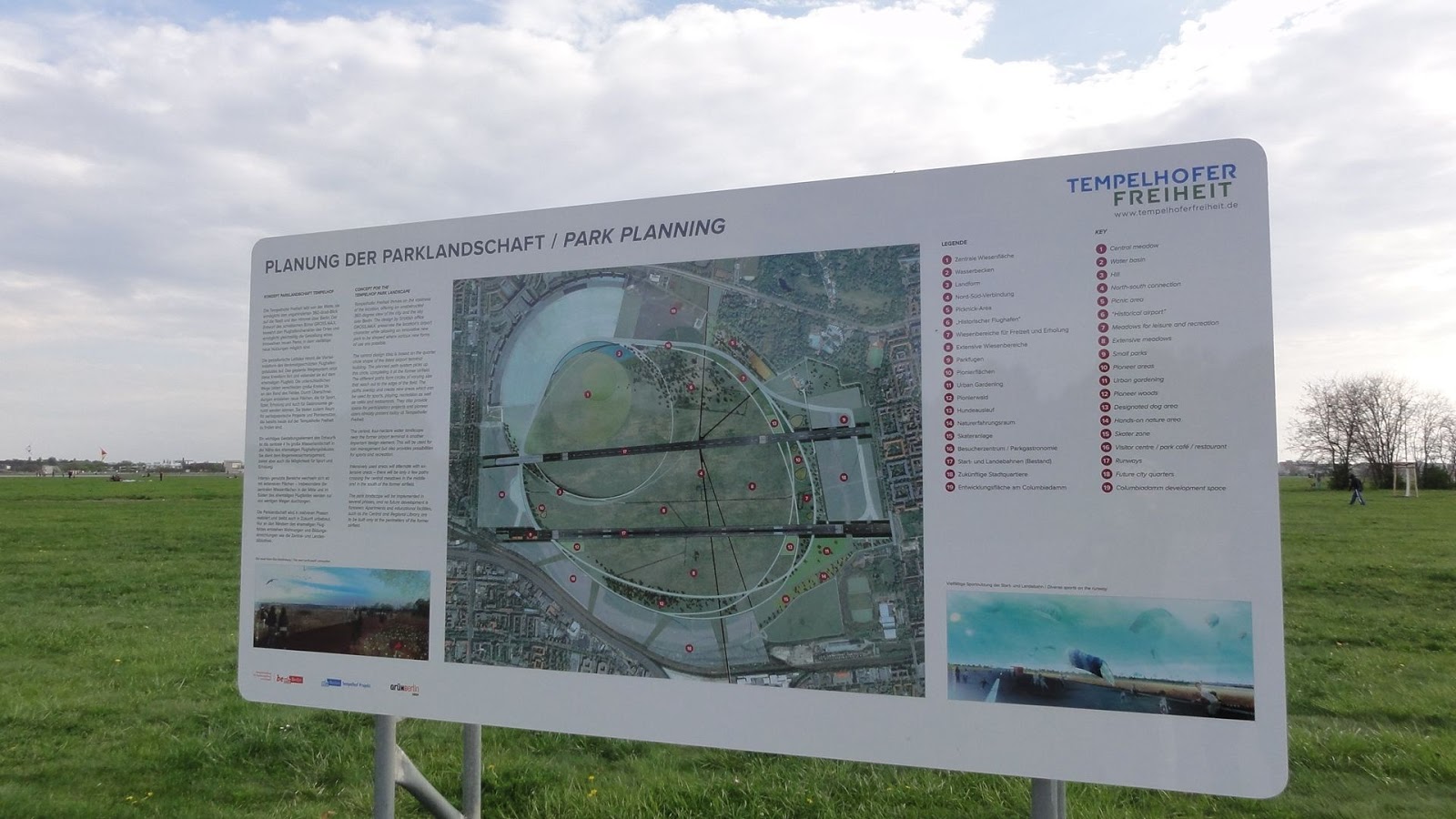
Information board about Tempelhofer Park

Panorama of Tempelhofer Park — low sling of building is the former terminal

Berliners barbecuing and picnicking in Tempelhofer Park

We’ve had a monumental walk over here, from Friedrichshein-Kreuzberg through Gorlitzer Park, onto Neukölln, and now to this strange airport-park. Along the way we were so absorbed in conversation that I sometimes had to remind myself to look around, to be a tourist. In Gorlitzer park, the fruit trees were exploding in almost surreal beauty. I couldn’t catch my breath as I took in trees unfurling savage pink blossoms in a series of stuttering realizations. In Neukölln, Jackie pointed out the hip cafes lining the street and claimed one was likely to hear American English in this part of town; when she first moved to Berlin 5 years ago it was completely different. She lived cheaply in Neokölln, very close to Temelhofer Park, and at that time it was totally Turkish and one rarely saw women or children on the street. All the establishments were Turkish owned. As if being driven in by the busload, “hipsters,” a group unidentifiable by race or ethnicity, have inundated Neokölln in the past couple years. Now the rents are higher, many of the Turkish establishments have been forced out of business, and many families evicted, Jackie says. But, on the topic of gentrification, Jackie is some sort of post-liberal: she says her eyes glaze over when the term gentrification is even mentioned because the history of cities is the history of cycles of gentrification. 

Self portrait with Berlin Cathedral on Museum Island

Tulips blossoming along the Spree

Fruit trees blossoming near the Oberbaumbrücke in Berlin

There is no doubt about it: Berlin is endlessly cool, way cooler than Amsterdam—more hip, more gritty, more nightlife, more street life. I love people watching in Berlin, I even love cruising in Berlin. Soon we exit the park and head into the heart of Kreuzberg and continue talking incessantly. Jackie says she feels like she is on drugs with me because we talk so much. To me it feels like we’re on some sort of connective brain transmission, corroborating all the things we have thought about but never expressed to anyone since we last saw each other. Clearly my whole point of coming to Europe on a cargo ship and struggling with the definition of home and loneliness was to meet Jackie here in Berlin and talk about it, at the very height of Spring. 

***

It’s almost bedtime for Jackie after a long day and little sleep. She’s enveloped in her duvet and about to nod off on the living room couch-bed in her shared flat. I’m flipping through channels on German television. Despite both of us being at the end of our battery packs, I ask her a huge question: What’s the deal with the Berlin Wall? I feel stupid even asking, since it’s a pretty famous part of history, but Jackie generously starts explaining what happened once the wall came down, even if her eye lids are drooping. I stop her—I need to know why the wall went up in the first place. She says simply that the Allies divided Berlin after WWII and the Soviets got East Berlin. The amazing nature of history and one’s place in it hits me: I knew the wall began to come down in 1989 and the reunification of Berlin was completed in 1990, but that was only 23 years ago. In the past 23 years, while I was coming further and further into adulthood in my own part of the world, the generations cycled through the growth and development of post-wall East Berlin unbeknownst to me, yet here I was, confronted with it on a very real basis. I was fascinated.

SLEEP IS COMMERCIAL:
Graffiti stencil on facade in Berlin, city of cool, well-placed Graffiti

Weird raised pipes that run throughout Berlin periodically (in Mitte)

Mural through dark driveway near Schlesisches Tor station of the U1

I have heard stories about disgruntled Berliners yelling things such as “Learn German!” from open windows when they hear someone on the street speaking in English. I have heard tales of graffiti signs on buildings that point an arrow to a window with a caption that reads, “Insert grenade here.” I have heard anecdotes about people sneering and saying, “Go back to America.” Jackie says some of the old time anarchist punk tenants that moved into her building in the 90s gave her roommates trouble for moving into their flat in the 00s. “Those high nose academics,” the neighbors said. Jackie retorts, “They did the same thing in the 90s! The neighborhood developed and became a cool place for people to live because they came here in the first place!” 

Reflection of illuminated trees in a Berlin canal 

Night scene along the Spree

Yours truly and Jackie on the Oberbaumbrücke

There is something interesting in my preference about getting my information from Jackie rather than a text-based source, be it online or a physical book. No doubt about it, I am a researcher at heart, but this time my preference is for the primary source interview. On my first night in Berlin, Jackie told me there was no summer one year in the 1800s. She said a late spring gradually gave way to an early fall. The pronouncement haunted me like a dream I couldn’t shake the entire next day as I wandered heavy, grey Mitte: losing such a cherished season was actually possible on this mysterious planet? Three days later, after we left Tempelhofer Park, we checked out The Amerika-Gedenkbibliothek (American Memorial Library) and Jackie pointed out the sign—she claimed the “Amerika” portion of the sign had been removed by protestors as part of a ballsy anti-America action a few years earlier. I wondered at Jackie possibly being nearby when that happened, of potentially being witness to it. In these two examples, the power of myth and vague memory propel the imagination: I found out later that indeed there was no summer in 1816 mostly because Mount Tambora in Indonesia erupted in April 1815, which was the biggest recorded volcano explosion in history. In actuality, there was no spring, summer, or fall in 1816, there was just a year of winter basically. As for the The Amerika-Gedenkbibliothek, that turned out to be total myth: the sign always just said GEDENKBIBLIOTHEK. I love these layers of information, and it makes me contemplate the nature of “trueness”–if Jackie’s description of the Year Without a Summer catapulted my imagination into motion, then I think her take on it was valuable, even if inaccurate, information. 

***

It’s my last night in Berlin and I am pretty sure I’ve fallen in love with every person I’ve met, except the Americans that started talking to us outside the cafe tonight. I cringed as they claimed to be from Los Angeles (but were originally from Texas), I muttered as I admitted I was born in Glendale, I shuddered as the homely sporty one tried to pick up on Jackie’s adorable German roommate. I suppose this exposes the shell of being the only American I’ve developed in the past few months, and I am ashamed of my internalized self-hatred although I can’t wait to complain about these Americans to Jackie. But the bigger theme is the dragon I’ve been chasing ever since I conceived of riding a cargo ship across the Atlantic: I want to be unique, I want to be the trend setter, I want to be unparalleled and in order for that to happen I don’t want homely, jet-lagged Americans talking to me loudly in a hip part of Berlin.

Intersection of Oppelnen Straße and Skalitzer Staße, Berlin

View of interesting architecture from the Oberbaumbrücke, Berlin
Sun setting through tunnel of the Kottbusser Tor station of the U1

Walking to the next bar, I finally get my chance to complain, but through the course of my diatribe I realize to be set on fire by Berlin means to writhe in its cultural complex. Earlier in the day, walking home from the Berlinische Gallerie, I was making hasty resolutions to learn German and emigrate to Berlin; in the afternoon I scrapped the plan, pinpointing all the cultural strife one would have to overcome; now, on the eve of my departure, I relished the strife as only an outsider could. I laughed at the Germans so fervently clinging to their language, their culture, their post-wall city. Racism is alive and well in Europe, I said to Jackie, while in the U.S. political correctness has ravished any attempt at a productive conversation, and while in Amsterdam, the clever Dutch have capitalized on their reputation of tolerance and good English speaking abilities.  

Sunday morning vantage between the U-bahn and S-bahn after a night of dancing at the Berghain

Luckauer Straße (easy easy easy easy easy)

Home sweet home: Görlitzer Bahnhof station of the U1

After a few more Cinco de Mayo shots of tequila (after all, Jackie and I did meet in San Francisco where the bastardized Mexican holiday is celebrated by getting wasted), we shuffle home under the rails of the U1 and Jackie promises me David Bowie’s newest music video, which is a tribute to the years he spent in Berlin in the 70s. She keeps saying everyone thought it was great because it was made by a famous videographer but she’ll wait for me to make my own pronouncement. I sense an indictment brewing. Once home, she cues it up on her laptop and I try to view it with an open mind. I think, well the song absolutely sucks. I think, who is that chick’s face? I think, why are there subtitles of the lyrics? Jackie yells, “How could anyone take this seriously?! All the names of the streets are spelled wrong!” 

With Jackie’s familiar world view I find something I had lost inside myself a long time ago: the courage to be outspoken, the self assurance to love, the promise of blossoms unfurling their petals. Spring has come to Europe and this won’t be another year without a summer. 

Blossoms...

...blossoms...

and more blossoming Berlin

Saturday, November 3, 2012

Grande Buenos Aires: The Media

Map:
As is common with freighter voyages, the dates and ports of calls of call differed from the first schedule I reported. Not only was the ship late in picking me up from Zarate, but it continued to fall behind schedule as my trip progressed. Sometimes I wonder if the Grimaldi fleet of cargo ships are hands on a watch running out of time as they ever more slowly completely their revolutions.

Here's what ended up happening:
(and it's annotated! Click the link below the map to get full notes and dates)


View Grande Buenos Aires Voyage in a larger map

Videos:
Here are a couple of my favorite videos, but check out my Youtube channel to view all my uploads.


Friday, November 2, 2012

The Grande Buenos Aires: The Last Days

The Grande Buenos Aires makes it way through the North Sea.

First came Emden. That tiny blip of neatly parked white cars and wind turbines towering across the horizon. Several crew members had disembarked and new faces started appearing in the hallways and on the decks. Faces of Italians and Indians I hadn’t just shared a life-transforming month with. The Germans’ disposition shifted and a bit after midnight on September 14 they drove their RV off the ro/ro ramp and out of the Grande Buenos Aires—earlier that night at dinner I had produced a bottle of California Pinot Noir (acquired back in Tilbury) for a toast to our camaraderie as the sole passengers. Even Peter who never drank had half a glass.

One of the last meals I shared with the Germans.
The majority of cargo in the Port of Emden, Germany seemed to be Audi automobiles, all wrapped in white protective coating.

Wind energy is big in North Europe. The new passengers told me it's bad for the sealife, though.
I don't know if they're right but I agreed with them anyway.

Early the next afternoon the ship was pulling out of the port. I hadn’t touched land.

Then came Hamburg. The trip up the river was long and scenic and I passed most of the day taking pictures on the deck even though I was shitting my pants: my spirit cruise was coming to an end in two or three days and I had lost track of time, thinking I had four or five days. The big bad world daunted me; all decisions had been made for me for the past 32 days; all meals prepared and fed to me; all bedding and towels washed and replaced. What was I going to do without my ship peeps, without this floating group home that moved at 18 knots and had a dead weight of 26,169 tons, without the structure and predictability of its routine?

It appeared as though many local Germans were taking advantage
of the early September mild weather by going for a sail in the Elbe river.

Some scenery coming up the Elbe river.
Notice Chief Cook Marcelo taking some pictures from the deck on the right.
The beginning of the river banks hosted more rural developments.
The industrial area of the port looms.
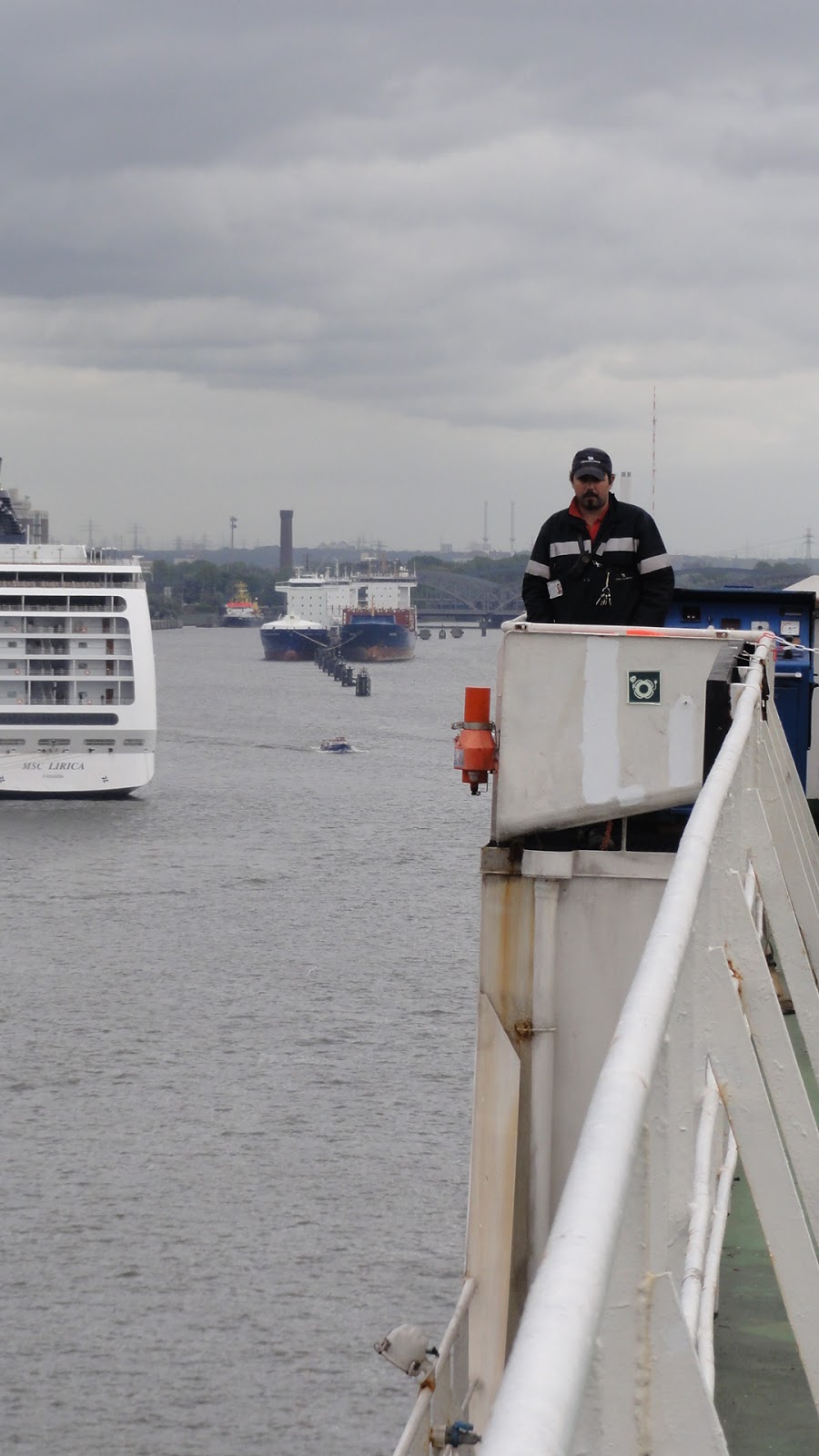
The Captain and the local pilots at work.

There was much evidence of nautical tourism and passenger ships near the city center.

Yours truly, wearing the stocking cap I got from the Seafarer's Centre in Tilbury.

Colorful facades inhabited the banks of the river Elbe nearer the center of Hamburg.

Many church steeples dotted the horizon, mixed with other towers and construction cranes.

This was a modern building being constructed on the water. It was interesting to see Hamburg's prosperity illustrated in the many construction cranes and mix of old and new architecture. 

The Chief Mate in position on the other side of the bridge.

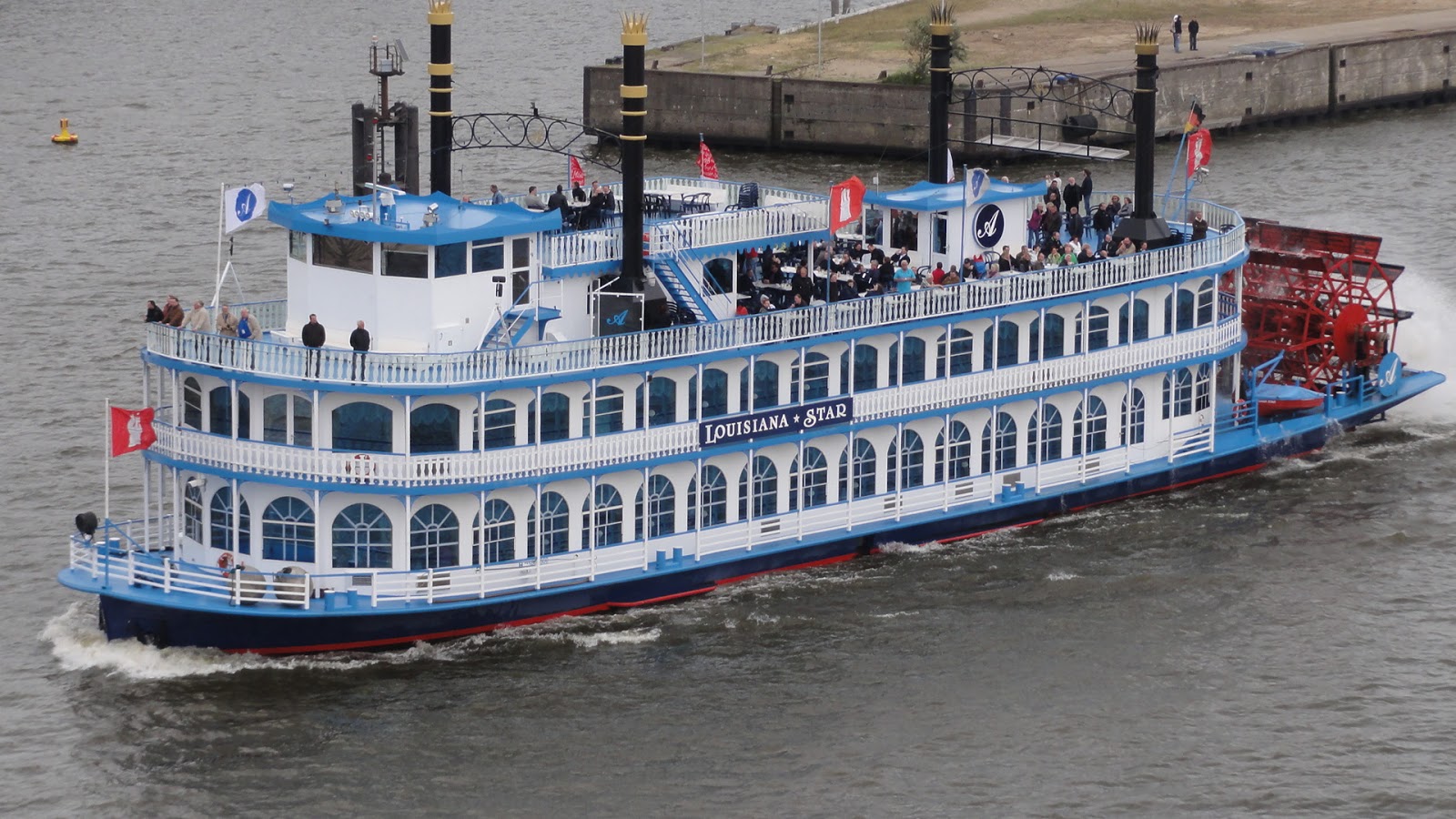
A little bit of good ol' America in Hamburg. The Louisiana Star!

 Well, if I had to disembark, we were going to go out in style. On Friday, September 14 Mikhail and I walked down the ro/ro hatch, got the port shuttle to the gates, and called a taxi. We got dropped off on St Pauli, which is basically Germany’s version of Vegas I soon realized: the streets teemed with regional Germans who had come to drink, gamble, ogle naked ladies, and hook up with prostitutes, the latter of which were neatly dressed and made up girls that lined the street corners with crisp black fanny packs strapped around their hips. (What a juxtaposition to the prostitutes of the Manila Discotee back in Vitoria, Brazil!) We had a few drinks at the 24 Carat Cocktail Bar, checked our email, walked around, ran into Marcelo and Filipo chowing down on doner kebab, and eventually became overwhelmed by the tourists looking for their weekend thrills before their looming weddings (Hamburg is the place for bachelor parties). Mikhail bought me a bouquet of roses from a street vendor, which was sweet: I love flowers and had wanted some in my cabin ever since I beheld the florist section of the Asda supermarket in Tilbury.

Checking our email and having a drink in the 24 Carat Cocktail Bar in Hamburg.

One side street comprised of adult entertainment businesses. There were so many people on the streets!

Party down, haha.
 A few short hours later, we decided to grab a cab and head back to the ship, but not without a bottle of Jameson, special request for the little lady! Our cab driver was a young Turk who spoke English well, so we told him our stories while we traversed the entire international shipping zone of Hamburg looking for a night shop that had Jameson. A few tries in, I settled for Valentine’s and we were finally deposited back at Terminal O’Swaldkai. We went to the galley, cut off the top of a water bottle, and plunged the peach roses into the warm sugar water I had concocted.

Oh dang, there goes one more day on the Grande Buenos Aires.

Our cab driver with the bottle of coveted whiskey. Disclaimer: I, a passenger of the Grande Buenos Aires, drank this whole bottle and didn't share with any crew :-P

Back on the ship, with my roses in the cut-off water bottle masquerading as a vase.

The next day the first wave of new passengers embarked: a couple of Dutch/Germans who were starting a two-year tour of South America that they had been dreaming of for 45 years. The remaining 10 passengers would board in Le Havre, long after I had disembarked. At dinner I began to pass my knowledge onto them as my previous fellow passengers had done when I embarked in Zarate all those days ago. What the meals usually consisted of, how much wine came with the meals, who ate where, how to send an email via satellite, the schedule of the steward (Mikhail)… but, I found myself losing patience with their wide-eyed sense of discovery, their lamentations they missed their dog, their disappointment the ship didn’t have wifi. This ship will change your life if you let it I almost wanted to shout at them.

Some of the cargo in the port included this public transit metro car, which looked pretty out of place among the construction equipment waiting to be loaded. 

The ship docked behind ours.

My Top Shop blouse flutters beautifully and forlornly in my cabin window while Hamburg passes outside.

Coming up the river to the Port of Antwerp on Monday, September 17 was bittersweet: it’s Belgium! It’s Antwerp! It’s the port! My two worlds collided: the first time I left the United States and my culture bubble burst was over 12 years ago and Antwerp, Belgium was the scene of the crime. That trip with my High School exchange program had transformed the way I looked at the world and had ignited my life-long obsession with travel and Europe. I remember being amazed at the smallest things, like how Diet Coke was Coca-Cola Light and how you had to pay to use a public restroom and how common fragrances like hand soap and deodorant just smelled different. Now, perhaps the one most perception-shifting travel experience since then, the Grande Buenos Aires, was going head-to-head with Belgium literally and figuratively. Who would win? I didn’t even want to take bets—I was still in denial I would be disembarking and maintained my desire to stay on the ship forever.

Back to sailing through the North Sea.

Entering into the port area of Antwerp, Belgium.

We were cruising next to this other cargo ship for a while.

Cargo cranes stand ready and at attention. 

The cadet raises the Belgian flag.

Traffic lanes in the Schelde river.

We waited in the lock next to this building for a while, and I caught the reflection of the ship's insignia in the reflective windows. Little did I know this would be the scene of immigration control when I left the port the next day. 

Waiting in the lock from the river to Grimaldi area of the port.
I ended up getting one extra night: we docked around 21:00 and I made arrangements to disembark the next morning at 10. I spent the night organizing my things, throwing away unneeded papers and brochures, consolidating toiletries, and did one last load of laundry. Slowly my little space transformed back into the generic cabin that all passengers encounter upon embarking. I kept going outside to watch a good chunk of the crew unload a truck of kitchen supplies, including crates and crates of bottled water, which were hoisted up to deck 12 and moved into the galley. Supplies I would never partake of.

I reluctantly left The Consoled by Kazuo Ishiguro, which I found in the ship's library, on the ship despite it being a beautiful hardback edition and despite the fact it was the best book I'd read in a long time. 
The ship's pantry shortly before restocking. Notice the crates of bottled water on the left.

Telltale signs of Italian and Indian fare: cans and cans of tomato sauce and bags and bags of  basmati rice.

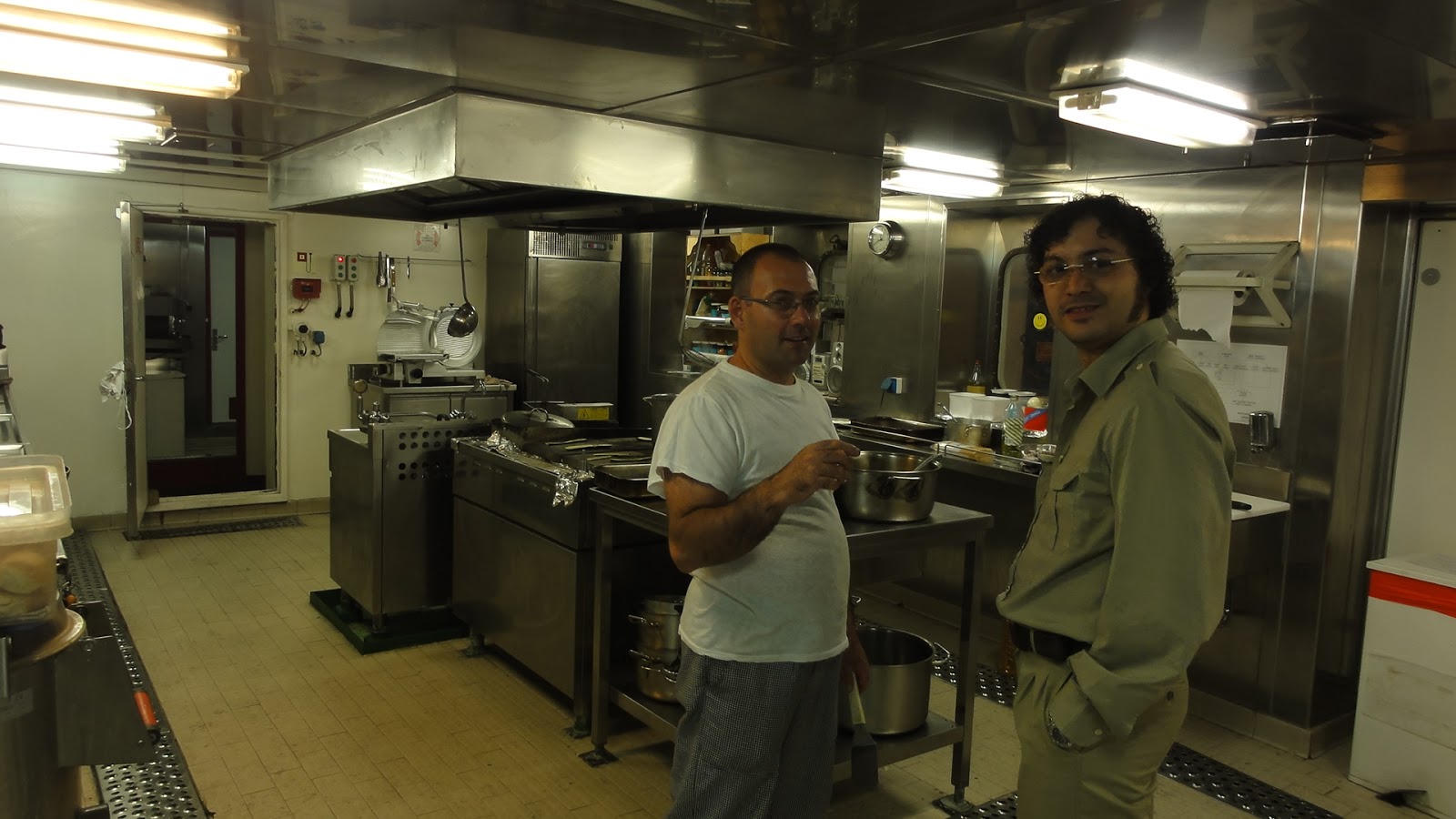
Chief cook Marcelo and Engine Officer Filipo in the galley. Filipo liked Marcelo because he made good Sicilian dishes and Filipo was obsessed with being Sicilian. 

The sunrise on September 18 was insanely ablaze; a bold red streaked through the morning thundercaps above the cranes of the port. Meanwhile, on the other side of the ship, it started raining and a brilliant rainbow pierced the grey sky. I tried to eat breakfast but could barely muster it; I was nervous about going into Antwerp and trying to find my friend Bahar, a holdover from the Belgian Exchange period who I hadn’t seen in 8 years. I was also really sad and was trying not to think about it. Nonetheless, Mikhail brought me a stock of wrapped sandwiches the Chief Cook Marcelo had whipped up. Whatever happened, I wouldn’t immediately starve upon disembarkation.

Amazing, yet ominous, red sunrise in the Port of Antwerp.
Red sky at night, sailors' delight.
Red sky in the morning, sailors heed the warning.
My dad taught me that one when I was young.
I went back to my cabin and finished packing up my backpack, trying to account for every possible scenario. Rain? Cold? Warm? Pleasant? I wrapped my shoes in a trash bag before inserting them into the netted pocket on the side of my back pack. I put the Sellotape I had purchased in Tilbury in my bag at the last moment—never know when you’ll need to tack up a map or poster to a barren wall. Everything empty, except the peach roses in the cut-off water bottle on the dresser that continued to open to a full bloom.

My bouquet sits by its lonesome on my dresser.

Bye bye familiar corridor. 
A few minutes before 10, Mikhail arrived at my cabin, picked up my bag, and we took the elevator down to deck 3, where I walked off the ro/ro hatch one last time. Crescenzo, the Chief Mate, Shona, Miguel, and some others were down there. Trying to keep my composure, I kissed each of them good-bye then we headed to my waiting taxi. Smiling, Mikhail said, “Have fun in Amsterdam, don’t drink too much, don’t smoke too much, be good,” and slammed the door shut. My eyes watering, watering, but I told myself: hold it together, you gotta go through immigration control, you gotta go to the city center, you gotta find Bahar.

And I did, I did do all those things, and I didn’t even cry.