|
| Throwing down anchor in Antwerp, Belgium. |
“Want to go to Brussels tonight?” Bahar asks as she cracks
two eggs in the pan she’s been frying some sausage in.
“Sure… I’m up for Brussels,” I respond, afraid to say no to
anything.
I’m sitting at the kitchen table of Bahar’s family in
Hoboken, Belgium (a suburb of Antwerp), chowing down on an assortment of
spreadable and sliced cheeses, deli meats, sliced tomatoes and cucumbers,
bread, sweet nutty specialties recently arrived from Turkey, hot tea and
cookies.
 |
| The most hospitable Bahar with a delicious cake of her own creation. She's quite the little baker and plans to open up her own pastry shop in Antwerp some day. |
“Well I’m working tonight at the restaurant in Brussels, so
you can come if you want,” Bahar says.
It's Tuesday, September 18 and I’ve only been on terra
firma for 3 hours yet I found Bahar (well, she found me scurrying from one
Quick fast food restaurant to another near Centraal Station) and I landed
smack dab in the middle of a typical Belgian brunch. I’m surrounded by her
brother, sister, and friend—her father’s around, working downstairs, and her
mother and other brother are due back from Turkey on Monday—and everyone’s
talking, bickering, and laughing. We’ve been excitedly catching up on the last
8, 10 years in details small and large. Obviously the tale of my sea voyage
has dominated the topic of conversation, but now Bahar has been telling me
about the Belgian restaurant chain she works for, whose specialty is
all-you-can-eat ribs.
 |
| Amadeus is The Place for Ribs. |
“I work from 6 to 12 so you’ll be alone, but I’ll try to get
off early and we can have a drink,” Bahar says. “You could eat ribs for dinner!”
Indeed a few hours later Bahar and I were on the highway from Antwerp to Brussels, and having some damn good conversation while she drove. Although we hadn't seen each other for 8 years and both confessed to being nervous at any possible awkwardness, we were picking up like old friends. A main topic of conversation was this year of being alone that I had embarked on. She couldn't quite empathize with what she viewed as me taking a huge risk, yet she shared her experiences doing an internship in Paris a few years ago, which was the longest she'd been away from home, on her own.
Upon arriving in Brussels, we got a parking spot across the street from her work and she marked some spots on the map then sent me on my way.
 |
| The Grote Markt of Brussels. |
 |
| Steeple in the Grote Markt (Grand Place) in Brussels, Belgium. |
 |
| Kelci and the Grote Markt. |
That night in Brussels I did not eat ribs (although I did on
another two occasions); instead I stuffed my face with the sandwiches the ship’s
Chief Chef had made for me that morning while I sauntered down Boulevard Du
Jardin Botanique at sunset. I suppose it was then I realized I had been half
expecting to get back on the ship that evening, that this was just another port
of call. I mulled this over while walking around for a few hours, having coffee
and writing in my notebook at a café, and walking around for another few hours.
I suppose I gave up and accepted my fate as just another ordinary land dweller, and finally came back to Bahar’s work
around 11:30, where she sat me at a table close to her dish-washing post and
started pouring me beers.
 |
| Reflection in the Magritte Museum. |
 |
| View from the top of the hill, near the Royal Palace. |
 |
| Square in front of the Grand Palace. Beautiful sky! |
 |
| Magritte's sky in a window of the Magritte Museum below a real life double. |
 |
| Sunset coming down Boulevard Du Jardin Botanique. |
 |
| We left Brussels sometime between 3 and 4 a.m., and enjoyed having the silent Grote Markt all to ourselves! |
I had vague recollections of visiting Brussels as part of the
Belgian exchange program through my High School when I was 17, but the most I could
remember was feeling alienated by the French influence—this city was not Belgian the way the cities we’d visited
in the North were, the way I’d come to know and regard Belgium in the short
week and half since our High School group arrived. I remember being
ushered hurriedly to Le Manneken Pis through narrow streets crammed with red
and white gingham-covered tables, and I remember being disappointed in the tiny boy
mounted on an out-of-the-way corner peeing, while grey heavy clouds loomed
above.
 |
| Cobalt sky at twilight in Brussels. |
 |
| Looking down Vlaamsesteenweg from St. Katelijneplein in Brussels. |
 |
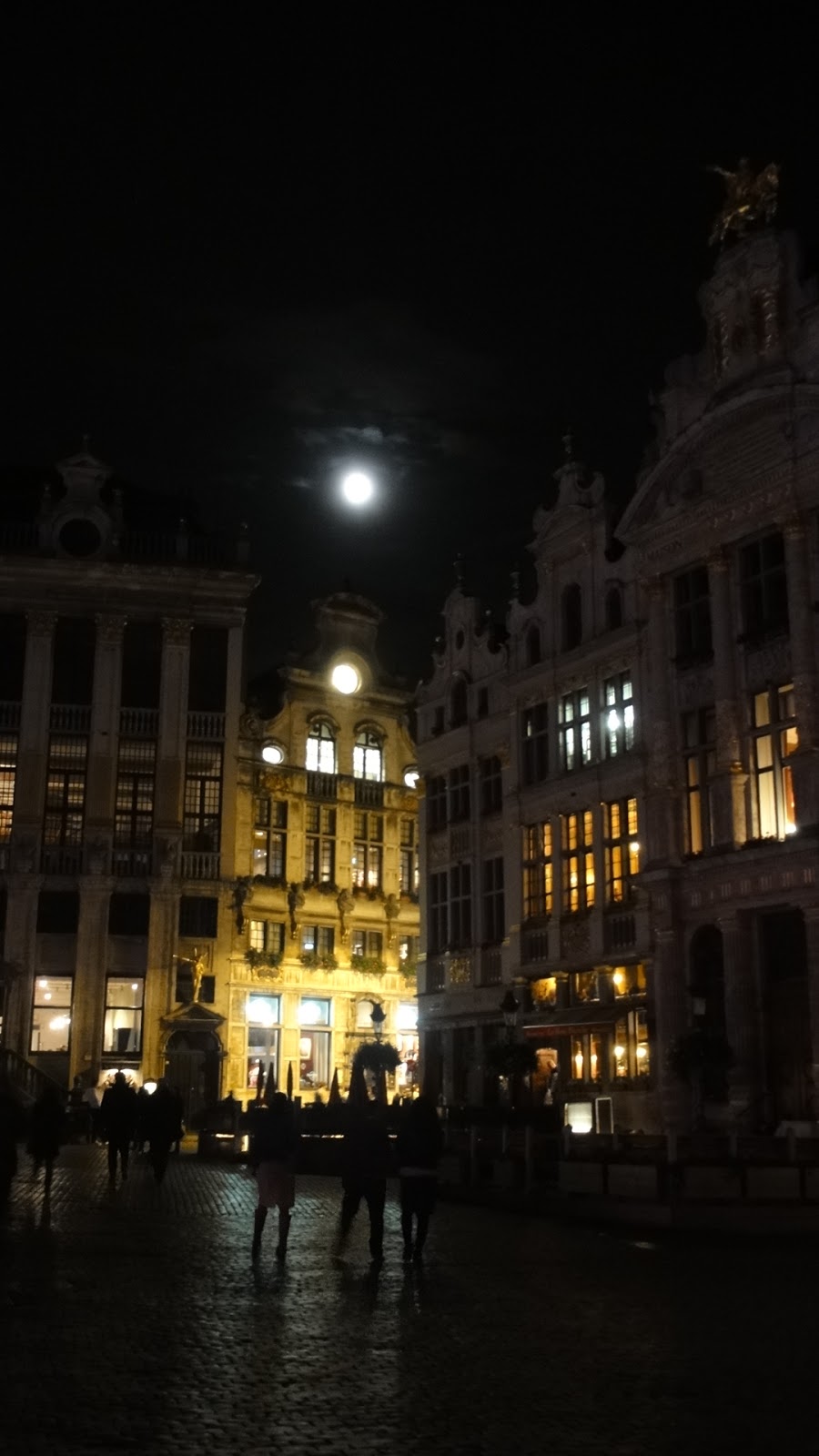
| Full moon over a guild house facade in the Grote Markt, Brussels. |
This time around I ended up visiting Brussels twice
—the first night of my stay with Bahar and again the last night, and both times Bahar left me to my own devices as she dutifully went to work in the restaurant. On my last night, I again
went in search of
Le Manneken Pis and found him on a corner surrounded by a
large group of tourists, even including a guided tour, taking pictures. I
literally couldn’t help but laugh at all of us, all of us come to find this
point of interest.
 |
| There he is! Surrounded by tourists! |
 |
| Kelci and the peeing boy. Can you tell by the look on my face I am suppressing a laugh on this absurdity? |
 |
| Bahar in front of a Burssels candy shop. Too bad it was closed because Bahar loves candy shops! |
Neither time I visited Brussels with Bahar could I get a
grip on the city—I wasn’t bothered by the French yet the city was strangely
international in a way I couldn’t put my finger on. It seemed overwhelmingly
young, like teenagers were particularly fond of partying on its literally red
carpeted streets, and Bahar and I managed to meet two business women and their
boss from Norway (that had been kicked out of a strip club earlier), a guy that
kept spitting on us (on accident) from Chile (who proclaimed to be the owner of the Irish pub we were sitting in front of), and two Romanians (one of which
was running a Greek restaurant and the other of which offered us the
Presidential Suite at the Sheraton). Only in Brussels was I bothered
persistently for cigarettes, and only in Brussels did young Moroccan boys get
in our face and hassle us to share our frits with them. (Although these things
are irritating, they don’t hold a candle to the way San Francisco crazies can
disturb you.)
 |
| Chowing down on ribs at the Antwerp location of the restaurant Bahar works in. |
 |
| Riding one of Bahar's bikes through the center of Antwerp, with the Cathedral of our Lady rising into the black sky behind me. |
Of course Bahar and I spent a lot of time in Antwerp,
good old Antwerp with its medieval winding alleys, cobblestone streets, guild house facades, and ornate cathedral. Bahar loves Antwerp and feels quite proud of her city—she thinks it's the perfect size, not too big and not too small, and it's easy to agree with her opinion that's it's beautiful. We hung out with her friends, went to the movies, partook in Belgian
specialties like waffles and frits, ate at restaurants, and frequented
cafes to sample the many wonderful beers Belgium has to offer. Bahar loves
sweet beers so we attempted to try as many new sweet beers—the stronger the
better—as we could find. Sometimes we would go to cute or unique cafes and
sometimes places specifically for their beer selection, like Bier Central near Centraal Station.
 |
| Waffles!! |
 |
| Partying down in Molly's Irish Pub in Antwerp. |
One particular night in
Ghent, after an afternoon spent at the sea in Blankenberge, we started out with
some usual choices, Kriek and La Chouffe, then progressed to more adventurous
choices: I ordered Bière De Miel Biologique—an organic honey beer—and Bahar
ordered Geuze Mariage Parfait—the perfect marriage. When the server brought the
beers, she gave me Bahar’s and vice versa. One sip of Bahar’s beer brought a
scowl to my face; an uncanny yeasty bitterness enveloped my mouth. I almost
said out loud, “Do I have to drink this?” but then Bahar realized the
switcheroo. If I couldn’t stand the hyper-fermented yogurt taste of the beer,
how was Bahar’s sweet palette going to handle it? Somehow, she managed, she
really suffered through it. What a champ! Later her efforts were rewarded by an
extremely drunk Belgian leaning on the table to talk to her and the table
flipping over, spilling her fresh beer all over her front. We took it as a sign—I
got a to-go cup for my remaining beer (yes, those exist at bars in Belgium!)
and we made our exit over the canal and out of the city center.
 |
| The Dreupelkot/Beer House in Ghent had a funny menu. "This is rather difficult to explain: Frenchmen say that foreigners are crazy; Holland people pretend to know best; and the Germans are always talking about their Reinheitsgebot, a 500 years old law concerning the prime materials used to produce beer. They are right for these beers,..." | | |
|
|
 |
| Our adventurous picks: Bière De Miel Biologique and Geuze Mariage Parfait. This was obviously before the drunk dude flipped the table over. |
 |
| Despite how disgusting Mariage Parfait was, Bahar finished it! Look at her empty glass! |
My third night in Belgium was another special one. Since
Bahar had to work, I went with her brother Mehmet to a party for the Erasmus
international students at UA (Universiteit Antwerpen), where everyone was supposed to
bring a food dish from their country. I appeared to be the only U.S. contingent
and had acquired a few boxes of chocolate chip cookies with the Statue of Liberty
on the package and a jar of peanut butter with an American flag stretched
across the label—American style! it
proclaimed. I instructed the confused students to slather the peanut butter on
the cookies; the few that did seemed to enjoy it and Mehmet agreed it was a
hit. As the night wore on I kept feeling secretly superior to everyone there: I
was here having a great time and I didn’t even have to be a student to do it!
The truth would come out as I got to talking to someone new—and there were a
lot of conversations that night—that I wasn’t actually a student at the
University, yet I had a great time meeting all the people from different
counties at the beginning of their semester in Belgium. After we left the party
in the University building, we loitered in one of the squares drinking and
smoking for a long time, went to a dance club in the red light district with a
couple Polish girls we had acquired along the way, and then Mehmet took me to
meet Bahar at a nearby pub where she was having a drink with a coworker. Bahar,
her coworker, and I ate doner kebab at a place run by goofy Turkish dudes then
we were chased down the street by drunken Belgian students who were trying to
throw a bicycle inner tube around our heads. All in a night in Antwerp!
 |
| Mehmet brought this Turkish dessert that sort of tasted like cotton candy but looked like strands of hair. Towards the end of the dinner we started up conversations with groups of people based on the premise they had to try this sweetness. The wasted girls on the left thought the candy made good mustaches. |
 |
| The Polish girls we acquired made some interesting shots called Mad Dogs. I was a big fan so I got the recipe: most of the shot glass filled with vodka, slowly pour a berry liqueur into the top, and a few dashes of Tabasco. LEKKER! |
 |
| Yours truly flanked by the Polish girls on some abandoned furniture outside University housing. |
 |
| The streets of the center of Antwerp are overtaken on Thursdays because it's students' night! |
Bahar was the perfect host; she embodies Turkish hospitality
in a completely overwhelming way to me. We went out almost every day, riding
our bikes to the center, or taking the train to the sea, or driving to
Brussels, and when she had to work she installed me with one of her family members.
So many times we would discuss plans to do separate things since she, you know,
had a life to attend to, and each time she would end up coming with me,
chaperoning us on another exciting adventure in Belgium. In a very perfect way,
she was the ideal landing pad for me; I almost can’t fathom how I would have
made the well-fed transition from boat-dweller to European city dweller without
Bahar and her warm family.
 |
| The one night we stayed home, after I got my hair done at her cousin's fabulous hair salon in Hoboken. |
A couple points of interest in Antwerp are the new
MAS museum and the
Flemish House of Literature (Letterenhuis). I wasn't able to view the collections of the former but I made it up to the observation terrace on the top floor just in time for a stunning rainbow that stretched across all of Antwerp. It was amazing! The trip to the MAS was worth that alone. As for the latter, the Letterenhuis, I can recommend it to anyone who is interested in/has studied literature and writing or anyone who is interested in the book as an object. The staff dutifully informed me none of the exhibits were in English, but I opted to have a look anyway. I was not disappointed! On the main floor, an exhaustive timeline of keypoints in Flemish literature kept pace with literary developments around the world, and many display cases held unique manuscripts and first editions by Flemish authors, usually surrounded by other ephemera from the same period.
 |
| The new MAS. |
 |
| Beautiful rainbow viewed from the roof of the MAS. |
 |
| This picture may suggest I am the pot of gold at the end of the rainbow. |
 |
| This text was on the wall in the women's bathroom of the Letterenhuis. Rough translation: "Life is not a book. The beginning is nowhere. It is here and there and yonder, and everything happens at once. A book is different." Louis Paul Boon, Abel Gholaerts (1944) |
 |
| Bahar and I enjoying the Belgian coast. |
 |
| Sunset over Blankenberge. |
 |
| Cargo ships making their way through the North Sea--that was me a week ago! |
 |
| Last bits of orange peeking through the clouds. |
 |
| Enjoying the sunset with a bottle of liebfraumilch. |
My favorite day was the afternoon we spent in Blankenberge,
which is a town on the coast of the North Sea in West Flanders. Once we came to
the beach, after walking down the shopping street from the train station,
something in me clicked: days before I had sailed past this town on the ship. I
recognized the sea and the clouds; I saw the cargo liners moving through their
routes close to the horizon. To the right was even a small port with cargo
cranes standing at the ready. Although I was in a transition period, I felt
serene on the sand before the water. It reminded me of San Francisco’s Ocean
Beach, the day I swam at Coney Island in New York with Cricket before I flew to Argentina, and the many waters the ship had sailed through. But now, almost three months
after I had left home, I was standing on the coast of the North Sea, mere kilometers
from my end goal: Amsterdam. My future and my past met each other here on the Belgian sand; one of my feet was in the sea and the other was taking the step towards Holland.