Showing posts with label the grande buenos aires. Show all posts

Monday, April 22, 2013

Being a Writer vs. Living as a Writer: The Story and the Stories about the Story


“And how much of that have you actually accomplished?” the third poet asks me. I had started the conversation when we were in line for the toilet, and now we’re packed into the door jam of the tiny venue, discussing what I do in Amsterdam. He had asked me if I study or work here? I answered I was working on a novel and a poetry chapbook inspired by my experience sailing on a cargo ship from Argentina to Belgium last summer. The stories about the story. 

“You rode on a cargo ship?” 

I answer the question the way I usually do, with the story I no longer want to tell: Yeah, I took a cargo ship across the Atlantic… it took 35 days... it was an Italian cargo ship... no, I didn’t work on the ship... My trademark Californian monotone. My gaze fixed toward the floor. I’ve told the story so much I now regard it as boring. Still, it remains central to my creative output. Still, it was immensely formidable to the following months. Still, my subconscious brandishes it like a medal of honor: in a recent nicotine patch dream I tried to choke out the story to long estranged friends I haven’t seen in years.

Interactive component of the MAS Museum in Antwerp, Belgium

In so many cities, in so many months I’ve used the stories about the story of the cargo ship as an alibi as if I needed one to be present: I’ve told artists, poets, landlords, friends, strangers, family members, and roommates that I’m writing a novel and a chapbook about my experience on a cargo ship. I’m trying to decide how much to make fiction and how much to make an historical account of oceanic shipping; I’m trying to decide how long the chapbook should be, how many individual poems I should include.


Shipping route diagram in the Port of Antwerp exhibit at the MAS Museum

I’m on a high speed train to Belgium, I’m sleepwalking through the Houston airport sobbing behind Versace sunglasses, I’m in a bar in New Orleans’s Marigny yelling above the jukebox, I’m getting ready to go to a squatter art space/dance club in Amsterdam and all the time I’m dragging the shackles of the story and the stories about the story behind me. I’m disappointed when people don’t ask more questions; I’m put out when someone latches on to its uniqueness. 

Gloves hanging above Hazenstraat in Amsterdam

But this is the thing: I’ve written in the novel only once since I left Amsterdam last fall. I’ve worked on the poetry chapbook only a few times since the New Year. My alibi is a fraud. 

* * *

The public library is typically low key for a weekend night. I’m curled up in one of the chairs by the windows on the 6th floor that cups its form around your body. Amsterdam’s understated yet enchanting skyline sits modestly across the Oosterdok and I’m not ashamed to be alone in the library on a Saturday night, chuckling to myself over the latest novel I’ve plucked from the Engels – Romans section. In fact, I am quite pleased with myself. 

Colorful view above Damsplein in Amsterdam;
twice yearly a carnival occupies the square

A couple weeks ago I sat in a kitchen in Antwerp and typed Skype messages as raindrops fell on the skylight above my head. I was messaging a very important figure that, in many ways, is the emblem of the cargo ship story and the novel/poetry-turned-alibi. Mikhail, my steward. Finishing my coffee and itching for a shower, I shook my head and turned off the screen of my iPad without responding to his last message. I rubbed my eyes wearily. I turned the iPad back on and tweeted, “I’m watching the end of my story develop right before my eyes.” It was settled, for me at least: I was never going to see him again. 

Cathedral of Our Lady in Antwerp, Belgium

More recently I passed out seven copies of a 13-page nonfiction essay double spaced and printed on good quality A4 sized paper to my writers workshop. In the weeks between sitting under the skylight in Antwerp and this moment in my writers workshop I had written and revised this essay four times. I pitched it to the Los Angeles Times Magazine and compiled a mental list of other places to submit it. I declined invitations to go out with my roommates and friends to work on this essay instead; I willfully logged off Twitter to turn my attention toward this essay. The subject of the essay was not the cargo ship, it was not the novel about the cargo ship, it was not the poetry chapbook about the cargo ship, and it was not even set within the last year. It went back to the beginning of 2011, to the time of the Japanese earthquake and tsunami and all that shook and flooded my private experiences of the same time. 


I am prey to a dangerous type of nostalgia: my nostalgia misdirects the affection for a specific place, time, and aura as affection for the current existence of the people who were there with me. The shorter the time period, the intenser the experience, the more likely this dangerous nostalgia will take root in my heart. I am left wandering neighborhoods that belong to the past alone, longing for the zeitgeist of the past period and obsessively remembering the people who use to be there. The only way to time travel and avoid sentimentality is to write, to encapsulate that past moment and its energy in a coherent composition. 

Facades on the island of Procida in Naples Province, Italy

In this way I mix up being a writer and living as a writer: there is some division between living the experiences that make for good stories and actually writing the stories, and I am still trying to find it. 

* * *

I’m dodging parked cars, laundry lines, scooters, and other pedestrians down Gradoni Chiaia in Naples; I’m growing dizzy watching the chaos of tiny cars, scooters, and motorcycles revolve around the Umberto-Sanfelice traffic circle; I’m swooning from the quiet solace the view from Castle St. Elmo provides on top of the hill, a breath-taking vantage of the city, its port, the bright Tyrrhenian Sea golden in the setting sun. This is where my people from the ship come from, and I recognize the willingness of the locals to communicate in bad Spanish, broken English, and gestures as the same welcoming temperament I found on the ship.

Congested traffic route of Gradoni Chiaia/Via St. Caterina  da Siena, Naples, Italy

I find Chief Chef Rafael’s cuisine in the courses served at Osteria della Mattonella one street over from our apartment: fried cod with its bones intact submerged in marinara sauce with floating olives and a soup of blended spinach with beans. I find the motion and familiar signage of my cargo ship in the ferry to the island of Ischia. I find Crescenzo’s hand movements in the baker’s and the private car driver’s communication methods. I find Fabio’s boyish good looks in the countenances of baristas running espresso shots down the narrow, cobble-stone streets. I find Gigi’s plump figure and sad smile buzzing through traffic on Corso Vittorio Emanuele on a grey Vespa. 

View of gulf of the Tyrrhenian Sea with cargo ship from Castle St. Elmo, Naples, Italy

I am here with my travel companion, a good old friend from Los Angeles, and I will not see anyone from the ship. I suppose I am trying to create new memories but really I am chasing the zeitgeist of the Grande Buenos Aires; despite this I fight my dangerous nostalgia with a reticent, road-worn heart. I observe Naples as an outsider; I will never delve into the real life experience of a Napolitano. Bittersweet is an understatement in this sense. I will spend most of my trip alternating between the melancholy this causes me and the euphoria the invigorating beauty brings me.

Panorama of Pompeii, Italy

It’s somewhere between Positano and Pompeii, on the only highway to and from the Almafi Coast, Via Guglielmo Marconi, that I realize it’s ok to wait a couple years to write the stories about the story of the cargo ship. It’s the distance I need to separate living as a writer from the coherent composition that will take shape. Sitting on top of a green hill at the back of the ancient town of Pompeii and lapping up the vista of the ruins, the modern town just at the border, and the Tyrrhenian at the horizon, I take solace in my recent writing endeavors: encapsulating the zeitgeist of the Japanese earthquake and tsunami in an essay, encapsulating my sleep deprived sophomore Spring semester in a poem, encapsulating the denial of the abandonment of my step-mother during my 4th grade Easter play in a poem. I don’t think these experiences are validated by the essays or the poems; the essays and poems are validated by my willingness to submerge myself in the original experience. 

View of Naples, the port, and the base of Mt. Vesuvio, Italy

As Clarice Lispector wrote, “I’ve looked into myself and discovered I want raw, bloody life.” 


Saturday, November 3, 2012

Grande Buenos Aires: The Media

Map:
As is common with freighter voyages, the dates and ports of calls of call differed from the first schedule I reported. Not only was the ship late in picking me up from Zarate, but it continued to fall behind schedule as my trip progressed. Sometimes I wonder if the Grimaldi fleet of cargo ships are hands on a watch running out of time as they ever more slowly completely their revolutions.

Here's what ended up happening:
(and it's annotated! Click the link below the map to get full notes and dates)


View Grande Buenos Aires Voyage in a larger map

Videos:
Here are a couple of my favorite videos, but check out my Youtube channel to view all my uploads.


Friday, November 2, 2012

The Grande Buenos Aires: The Last Days

The Grande Buenos Aires makes it way through the North Sea.

First came Emden. That tiny blip of neatly parked white cars and wind turbines towering across the horizon. Several crew members had disembarked and new faces started appearing in the hallways and on the decks. Faces of Italians and Indians I hadn’t just shared a life-transforming month with. The Germans’ disposition shifted and a bit after midnight on September 14 they drove their RV off the ro/ro ramp and out of the Grande Buenos Aires—earlier that night at dinner I had produced a bottle of California Pinot Noir (acquired back in Tilbury) for a toast to our camaraderie as the sole passengers. Even Peter who never drank had half a glass.

One of the last meals I shared with the Germans.
The majority of cargo in the Port of Emden, Germany seemed to be Audi automobiles, all wrapped in white protective coating.

Wind energy is big in North Europe. The new passengers told me it's bad for the sealife, though.
I don't know if they're right but I agreed with them anyway.

Early the next afternoon the ship was pulling out of the port. I hadn’t touched land.

Then came Hamburg. The trip up the river was long and scenic and I passed most of the day taking pictures on the deck even though I was shitting my pants: my spirit cruise was coming to an end in two or three days and I had lost track of time, thinking I had four or five days. The big bad world daunted me; all decisions had been made for me for the past 32 days; all meals prepared and fed to me; all bedding and towels washed and replaced. What was I going to do without my ship peeps, without this floating group home that moved at 18 knots and had a dead weight of 26,169 tons, without the structure and predictability of its routine?

It appeared as though many local Germans were taking advantage
of the early September mild weather by going for a sail in the Elbe river.

Some scenery coming up the Elbe river.
Notice Chief Cook Marcelo taking some pictures from the deck on the right.
The beginning of the river banks hosted more rural developments.
The industrial area of the port looms.
The Captain and the local pilots at work.

There was much evidence of nautical tourism and passenger ships near the city center.

Yours truly, wearing the stocking cap I got from the Seafarer's Centre in Tilbury.

Colorful facades inhabited the banks of the river Elbe nearer the center of Hamburg.

Many church steeples dotted the horizon, mixed with other towers and construction cranes.

This was a modern building being constructed on the water. It was interesting to see Hamburg's prosperity illustrated in the many construction cranes and mix of old and new architecture. 

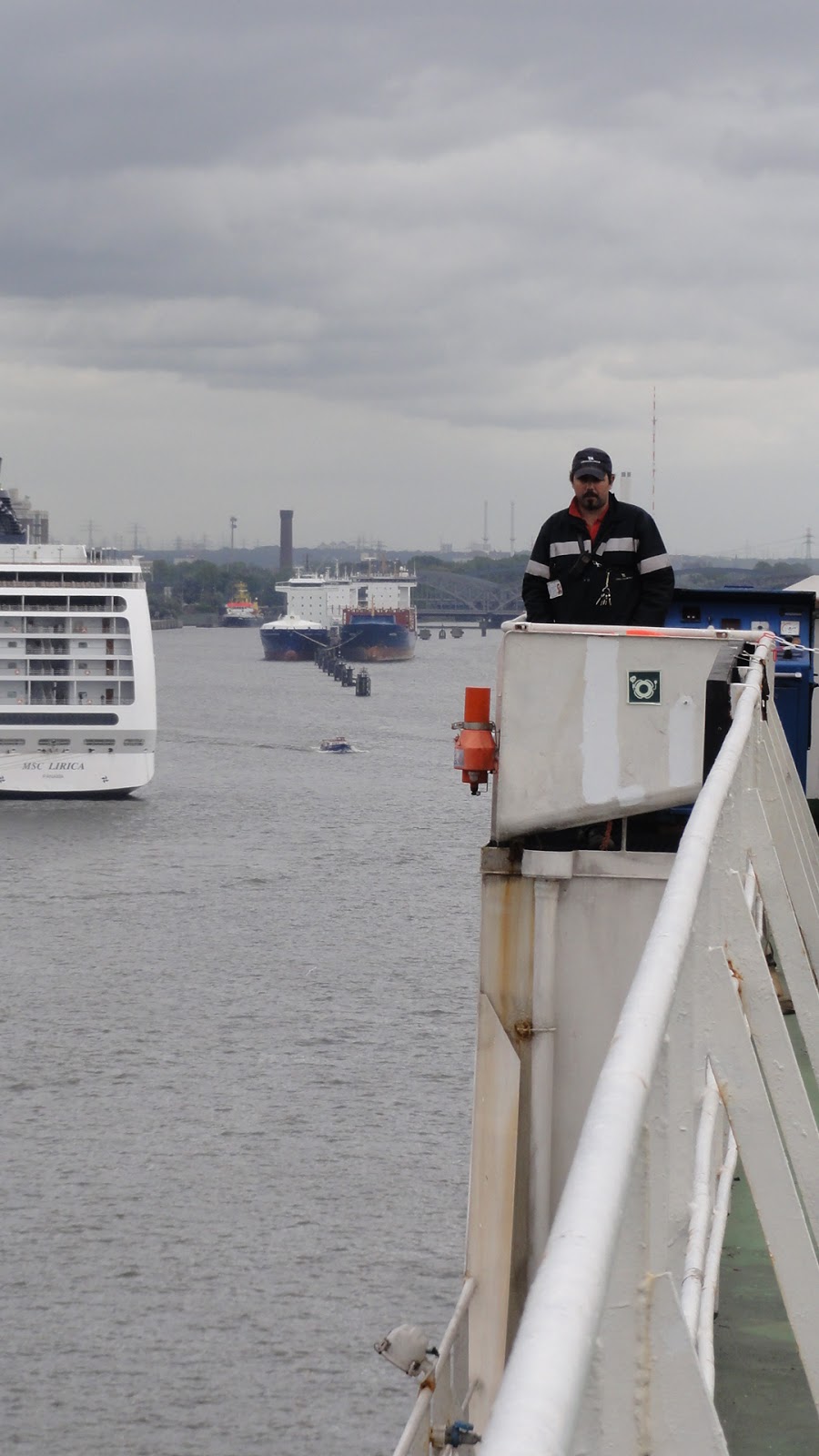
The Chief Mate in position on the other side of the bridge.

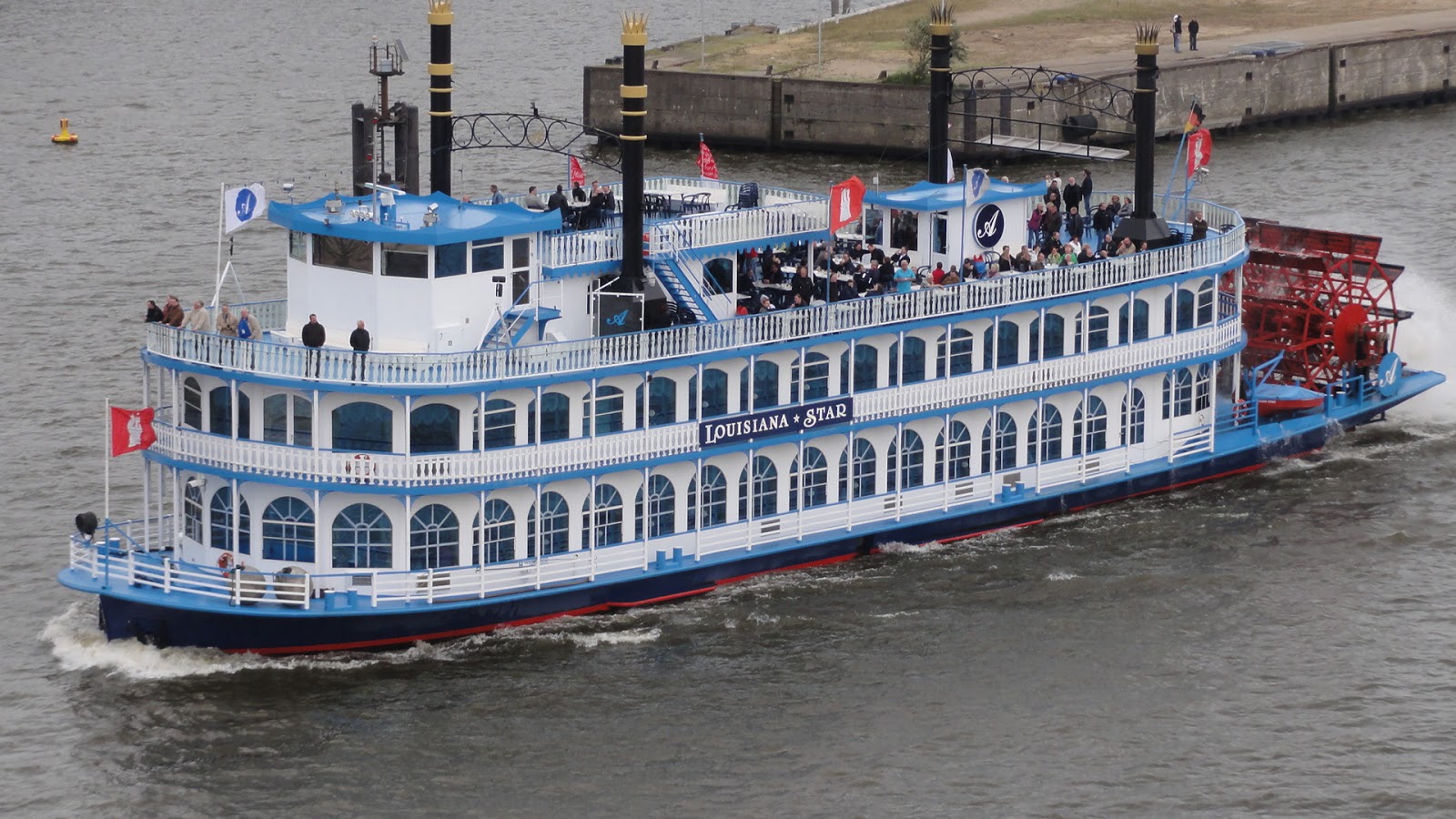
A little bit of good ol' America in Hamburg. The Louisiana Star!

 Well, if I had to disembark, we were going to go out in style. On Friday, September 14 Mikhail and I walked down the ro/ro hatch, got the port shuttle to the gates, and called a taxi. We got dropped off on St Pauli, which is basically Germany’s version of Vegas I soon realized: the streets teemed with regional Germans who had come to drink, gamble, ogle naked ladies, and hook up with prostitutes, the latter of which were neatly dressed and made up girls that lined the street corners with crisp black fanny packs strapped around their hips. (What a juxtaposition to the prostitutes of the Manila Discotee back in Vitoria, Brazil!) We had a few drinks at the 24 Carat Cocktail Bar, checked our email, walked around, ran into Marcelo and Filipo chowing down on doner kebab, and eventually became overwhelmed by the tourists looking for their weekend thrills before their looming weddings (Hamburg is the place for bachelor parties). Mikhail bought me a bouquet of roses from a street vendor, which was sweet: I love flowers and had wanted some in my cabin ever since I beheld the florist section of the Asda supermarket in Tilbury.

Checking our email and having a drink in the 24 Carat Cocktail Bar in Hamburg.

One side street comprised of adult entertainment businesses. There were so many people on the streets!

Party down, haha.
 A few short hours later, we decided to grab a cab and head back to the ship, but not without a bottle of Jameson, special request for the little lady! Our cab driver was a young Turk who spoke English well, so we told him our stories while we traversed the entire international shipping zone of Hamburg looking for a night shop that had Jameson. A few tries in, I settled for Valentine’s and we were finally deposited back at Terminal O’Swaldkai. We went to the galley, cut off the top of a water bottle, and plunged the peach roses into the warm sugar water I had concocted.

Oh dang, there goes one more day on the Grande Buenos Aires.

Our cab driver with the bottle of coveted whiskey. Disclaimer: I, a passenger of the Grande Buenos Aires, drank this whole bottle and didn't share with any crew :-P

Back on the ship, with my roses in the cut-off water bottle masquerading as a vase.

The next day the first wave of new passengers embarked: a couple of Dutch/Germans who were starting a two-year tour of South America that they had been dreaming of for 45 years. The remaining 10 passengers would board in Le Havre, long after I had disembarked. At dinner I began to pass my knowledge onto them as my previous fellow passengers had done when I embarked in Zarate all those days ago. What the meals usually consisted of, how much wine came with the meals, who ate where, how to send an email via satellite, the schedule of the steward (Mikhail)… but, I found myself losing patience with their wide-eyed sense of discovery, their lamentations they missed their dog, their disappointment the ship didn’t have wifi. This ship will change your life if you let it I almost wanted to shout at them.

Some of the cargo in the port included this public transit metro car, which looked pretty out of place among the construction equipment waiting to be loaded. 

The ship docked behind ours.

My Top Shop blouse flutters beautifully and forlornly in my cabin window while Hamburg passes outside.

Coming up the river to the Port of Antwerp on Monday, September 17 was bittersweet: it’s Belgium! It’s Antwerp! It’s the port! My two worlds collided: the first time I left the United States and my culture bubble burst was over 12 years ago and Antwerp, Belgium was the scene of the crime. That trip with my High School exchange program had transformed the way I looked at the world and had ignited my life-long obsession with travel and Europe. I remember being amazed at the smallest things, like how Diet Coke was Coca-Cola Light and how you had to pay to use a public restroom and how common fragrances like hand soap and deodorant just smelled different. Now, perhaps the one most perception-shifting travel experience since then, the Grande Buenos Aires, was going head-to-head with Belgium literally and figuratively. Who would win? I didn’t even want to take bets—I was still in denial I would be disembarking and maintained my desire to stay on the ship forever.

Back to sailing through the North Sea.

Entering into the port area of Antwerp, Belgium.

We were cruising next to this other cargo ship for a while.

Cargo cranes stand ready and at attention. 

The cadet raises the Belgian flag.

Traffic lanes in the Schelde river.

We waited in the lock next to this building for a while, and I caught the reflection of the ship's insignia in the reflective windows. Little did I know this would be the scene of immigration control when I left the port the next day. 

Waiting in the lock from the river to Grimaldi area of the port.
I ended up getting one extra night: we docked around 21:00 and I made arrangements to disembark the next morning at 10. I spent the night organizing my things, throwing away unneeded papers and brochures, consolidating toiletries, and did one last load of laundry. Slowly my little space transformed back into the generic cabin that all passengers encounter upon embarking. I kept going outside to watch a good chunk of the crew unload a truck of kitchen supplies, including crates and crates of bottled water, which were hoisted up to deck 12 and moved into the galley. Supplies I would never partake of.

I reluctantly left The Consoled by Kazuo Ishiguro, which I found in the ship's library, on the ship despite it being a beautiful hardback edition and despite the fact it was the best book I'd read in a long time. 
The ship's pantry shortly before restocking. Notice the crates of bottled water on the left.

Telltale signs of Italian and Indian fare: cans and cans of tomato sauce and bags and bags of  basmati rice.

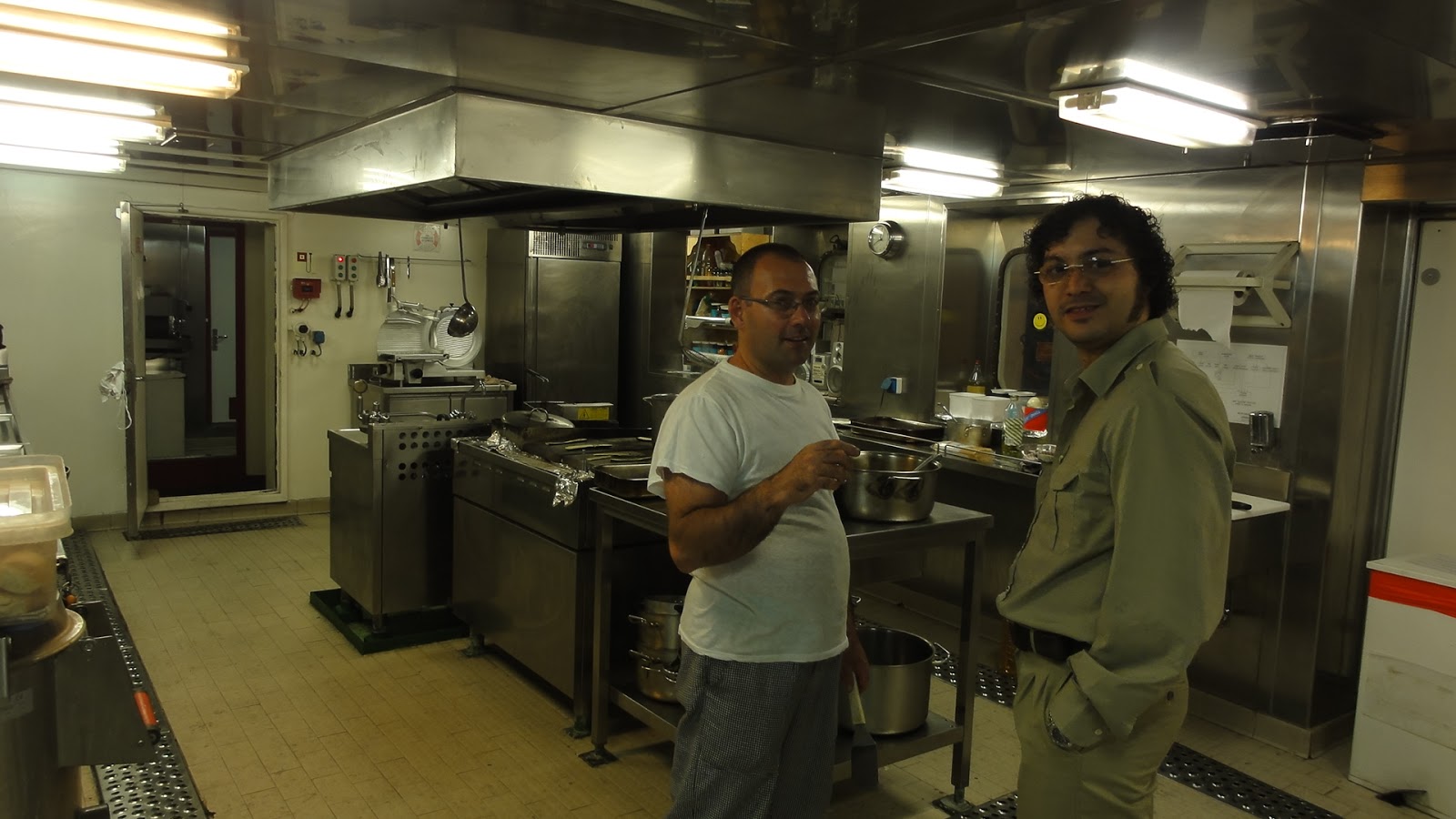
Chief cook Marcelo and Engine Officer Filipo in the galley. Filipo liked Marcelo because he made good Sicilian dishes and Filipo was obsessed with being Sicilian. 

The sunrise on September 18 was insanely ablaze; a bold red streaked through the morning thundercaps above the cranes of the port. Meanwhile, on the other side of the ship, it started raining and a brilliant rainbow pierced the grey sky. I tried to eat breakfast but could barely muster it; I was nervous about going into Antwerp and trying to find my friend Bahar, a holdover from the Belgian Exchange period who I hadn’t seen in 8 years. I was also really sad and was trying not to think about it. Nonetheless, Mikhail brought me a stock of wrapped sandwiches the Chief Cook Marcelo had whipped up. Whatever happened, I wouldn’t immediately starve upon disembarkation.

Amazing, yet ominous, red sunrise in the Port of Antwerp.
Red sky at night, sailors' delight.
Red sky in the morning, sailors heed the warning.
My dad taught me that one when I was young.
I went back to my cabin and finished packing up my backpack, trying to account for every possible scenario. Rain? Cold? Warm? Pleasant? I wrapped my shoes in a trash bag before inserting them into the netted pocket on the side of my back pack. I put the Sellotape I had purchased in Tilbury in my bag at the last moment—never know when you’ll need to tack up a map or poster to a barren wall. Everything empty, except the peach roses in the cut-off water bottle on the dresser that continued to open to a full bloom.

My bouquet sits by its lonesome on my dresser.

Bye bye familiar corridor. 
A few minutes before 10, Mikhail arrived at my cabin, picked up my bag, and we took the elevator down to deck 3, where I walked off the ro/ro hatch one last time. Crescenzo, the Chief Mate, Shona, Miguel, and some others were down there. Trying to keep my composure, I kissed each of them good-bye then we headed to my waiting taxi. Smiling, Mikhail said, “Have fun in Amsterdam, don’t drink too much, don’t smoke too much, be good,” and slammed the door shut. My eyes watering, watering, but I told myself: hold it together, you gotta go through immigration control, you gotta go to the city center, you gotta find Bahar.

And I did, I did do all those things, and I didn’t even cry.