Showing posts with label gypsy girl. Show all posts

Saturday, February 21, 2015

An Apology

This is an apology for going away, for leaving you, for not doing the best job at my challenge, for coming back, for wanting to pretend like it never happened, for using it as an excuse.

This is a note of self-forgiveness—there was no other way it could have happened. I wanted it so badly that proving to myself I could do it is worth more that the regrets, although I regret it everyday. I did the best I could, I planned it the best I could. I didn't expect for it to traumatize me so psychically. I didn't expect my plan to backfire so tremendously.

This is a vague reference to my milestones of danger and survival: the infections, the illnesses, the encounters, the bizarre self-created storylines. 

Whose forgiveness do I seek? 

***


In the days leading up to my departure from Amsterdam, the hot water broke in the the illegal public-housing sublet my roommates and I inhabited. I could not take a hot shower. I lugged buckets of boiled water up the stairs to the bathroom, and bathing involved standing in a dish tub with a rag.

In the days leading up to my departure from Amsterdam, I took impulsive bike rides into the city center, quickly selecting and purchasing apparel from Esprit, Didi, Mexx in a whirlwind of muted sentimentality. I was fixating on the extra suitcase I would bring back: finally I acquired it from a second hand shop in Westerpark, a hard shelled navy blue Samsonite. The center of my purpose was packing the suitcase: purple sweater dress, bottles of cranberry wine from Vlieland, Amsterdam map collage, playing cards from a local artist on Witte de Withstraat, luikse wafels, stroop wafels, jumper from Ameland, fuzzy Esprit sweater, Dutch toiletries... and the things that could not fit and would be left behind... As the physical weight of the suitcase grew, its weight as proof—as evidence—likewise grew. My productivity abroad was directly correlated to this suitcase arriving in San Francisco intact and as a fully realized souvenir, while the nostalgia it represented weighed down my ability to proceed into San Francisco unhindered.

But when I think of this I don't think of the metaphysical weight the suitcase put on my psyche; I think of the often overcast summer slowly opening the trees along the canals, the distinct sound of Dutch-Moroccan children playing, and the rush of the sun shining in the afternoon. My misery was the two sides of leaving: the happiness at going home finally, and the reluctant acceptance that I would never have another experience like this again, that time I tried to live in Amsterdam when I was 30.


***

On July 1, 2013, I flew direct from Amsterdam to Philadelphia. When passing through immigration at Schiphol Airport, I was detained for overstaying my tourist visa, and was ultimately banned from entering the EU until July 1, 2014. When I arrived at PHL, the United States was mine, it was foreign, it was fascinating, it was home, I was still an outsider, I had endured many abuses at the hands of myself and of culture and of loneliness.

Watching the 4th of July fireworks from under the Echo Bridge on the Schuylkill River, I began to move on from the abuses: a sliver of resignation, a sliver of aggression: the way you feel when you discover the thing you pined for all your twenties just destroyed you, and you could not have kept living without having been destroyed... But maybe you still believe it's possible to fall in love. 


***

The one thing I learned from Amsterdam is that I need a reason to get up most days of the week, I need the pressure of something at times disdainful to be successful.

I couldn't wait to get away from the thing that made me get up at 7:20 a.m. five mornings a week, and then I was miserable and depressed when I didn't have that very thing, even though theoretically I had Amsterdam.

What is a human without a routine?

I was going back to my job at the library, and couldn't be happier. 

***
 
When the hard shelled navy Samsonite suitcase finally made its way across the U.S., from the Philadelphia Greyhound station to the San Francisco Greyhound station and to my apartment in the Richmond District, opening it was an aromatic poof of my abuses: all the second hand smoke that had clung to the walls and furniture of my room in Amsterdam, a parting gift from the previous inhabit; the light traces of my roommates' Dutch fabric softeners; even the changing seasons on the street and the stiffness brought from hanging clothes to dry in a staircase.

Nineteen months ago I returned to San Francisco, my home: the place where I understand the weather, the place I grew into an adult, the place where my mom has made a life with me. I'm a strange nationalist, a Californian. California, my favorite country.

This blog proceeds accordingly, having honored its mandate for ashamed and/or reflective silence.

Wednesday, May 22, 2013

Single Sweet May in Berlin


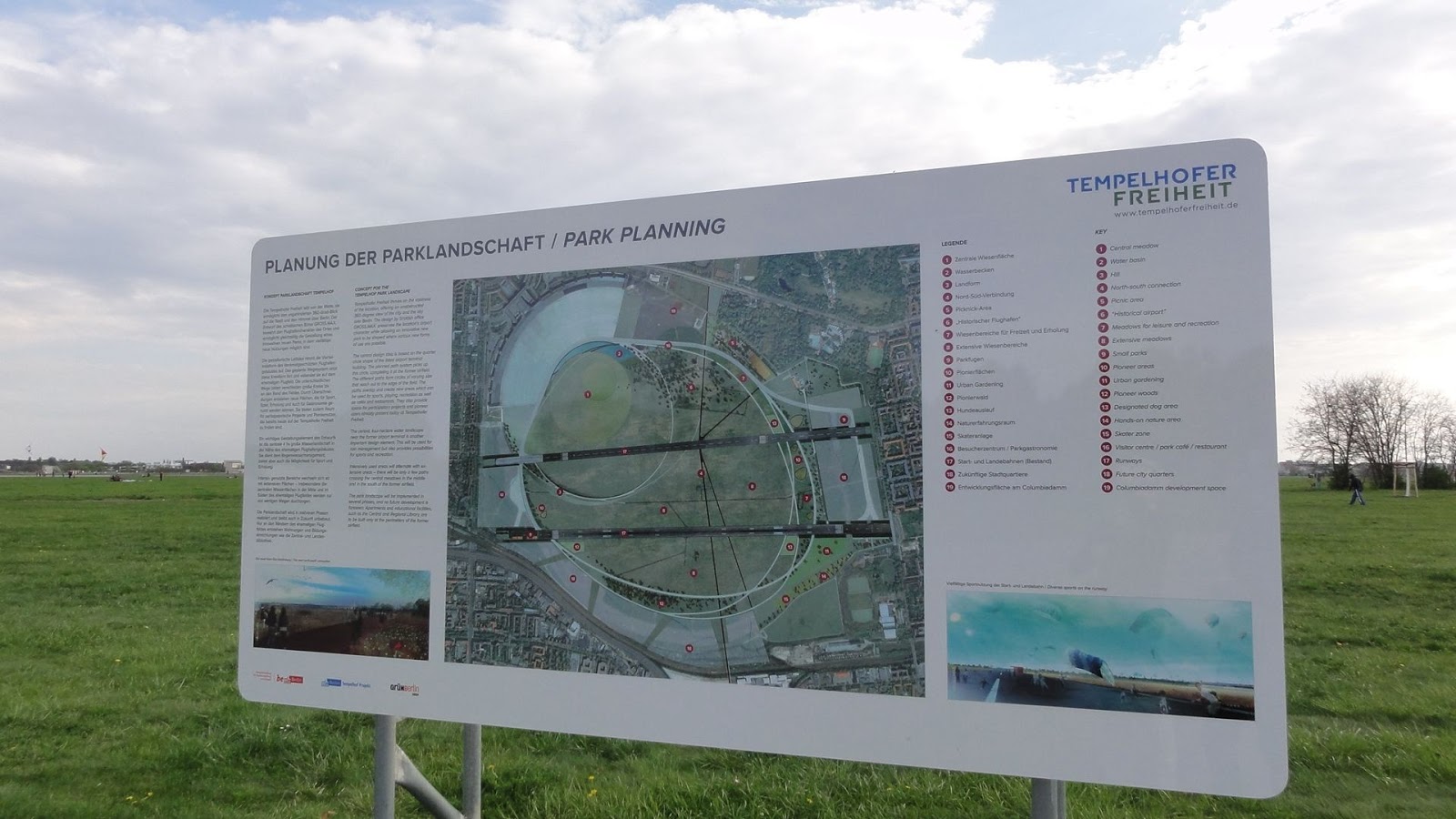
My friend Jackie and I are walking through Tempelhofer Park in Berlin, a park whose empty terminal is still and tiny across the wide expanse of the old runway. Tempelhof Airport was actively receiving and departing airplanes until 2008, then it became a park, and there has been controversy over redevelopment plans ever since. 

But today the weather is perfect, the sky mostly blue, and packs of casual, hip Berliners have swarmed the park for picnics and barbecues. Jackie and I sit for a moment and drink from our bottles of Club Mate and finish our conversation. We have been talking nonstop the past few days, and everything I have learned about Berlin Jackie taught me. But right now we’re talking about the personal, finishing our conversation about the afterlife—Jackie mentions her roommate’s philosophical take, which she says has calmed her anxiety about dying: her roommate says between life and death, only life exists if death is the end of consciousness. 

Information board about Tempelhofer Park

Panorama of Tempelhofer Park — low sling of building is the former terminal

Berliners barbecuing and picnicking in Tempelhofer Park

We’ve had a monumental walk over here, from Friedrichshein-Kreuzberg through Gorlitzer Park, onto Neukölln, and now to this strange airport-park. Along the way we were so absorbed in conversation that I sometimes had to remind myself to look around, to be a tourist. In Gorlitzer park, the fruit trees were exploding in almost surreal beauty. I couldn’t catch my breath as I took in trees unfurling savage pink blossoms in a series of stuttering realizations. In Neukölln, Jackie pointed out the hip cafes lining the street and claimed one was likely to hear American English in this part of town; when she first moved to Berlin 5 years ago it was completely different. She lived cheaply in Neokölln, very close to Temelhofer Park, and at that time it was totally Turkish and one rarely saw women or children on the street. All the establishments were Turkish owned. As if being driven in by the busload, “hipsters,” a group unidentifiable by race or ethnicity, have inundated Neokölln in the past couple years. Now the rents are higher, many of the Turkish establishments have been forced out of business, and many families evicted, Jackie says. But, on the topic of gentrification, Jackie is some sort of post-liberal: she says her eyes glaze over when the term gentrification is even mentioned because the history of cities is the history of cycles of gentrification. 

Self portrait with Berlin Cathedral on Museum Island

Tulips blossoming along the Spree

Fruit trees blossoming near the Oberbaumbrücke in Berlin

There is no doubt about it: Berlin is endlessly cool, way cooler than Amsterdam—more hip, more gritty, more nightlife, more street life. I love people watching in Berlin, I even love cruising in Berlin. Soon we exit the park and head into the heart of Kreuzberg and continue talking incessantly. Jackie says she feels like she is on drugs with me because we talk so much. To me it feels like we’re on some sort of connective brain transmission, corroborating all the things we have thought about but never expressed to anyone since we last saw each other. Clearly my whole point of coming to Europe on a cargo ship and struggling with the definition of home and loneliness was to meet Jackie here in Berlin and talk about it, at the very height of Spring. 

***

It’s almost bedtime for Jackie after a long day and little sleep. She’s enveloped in her duvet and about to nod off on the living room couch-bed in her shared flat. I’m flipping through channels on German television. Despite both of us being at the end of our battery packs, I ask her a huge question: What’s the deal with the Berlin Wall? I feel stupid even asking, since it’s a pretty famous part of history, but Jackie generously starts explaining what happened once the wall came down, even if her eye lids are drooping. I stop her—I need to know why the wall went up in the first place. She says simply that the Allies divided Berlin after WWII and the Soviets got East Berlin. The amazing nature of history and one’s place in it hits me: I knew the wall began to come down in 1989 and the reunification of Berlin was completed in 1990, but that was only 23 years ago. In the past 23 years, while I was coming further and further into adulthood in my own part of the world, the generations cycled through the growth and development of post-wall East Berlin unbeknownst to me, yet here I was, confronted with it on a very real basis. I was fascinated.

SLEEP IS COMMERCIAL:
Graffiti stencil on facade in Berlin, city of cool, well-placed Graffiti

Weird raised pipes that run throughout Berlin periodically (in Mitte)

Mural through dark driveway near Schlesisches Tor station of the U1

I have heard stories about disgruntled Berliners yelling things such as “Learn German!” from open windows when they hear someone on the street speaking in English. I have heard tales of graffiti signs on buildings that point an arrow to a window with a caption that reads, “Insert grenade here.” I have heard anecdotes about people sneering and saying, “Go back to America.” Jackie says some of the old time anarchist punk tenants that moved into her building in the 90s gave her roommates trouble for moving into their flat in the 00s. “Those high nose academics,” the neighbors said. Jackie retorts, “They did the same thing in the 90s! The neighborhood developed and became a cool place for people to live because they came here in the first place!” 

Reflection of illuminated trees in a Berlin canal 

Night scene along the Spree

Yours truly and Jackie on the Oberbaumbrücke

There is something interesting in my preference about getting my information from Jackie rather than a text-based source, be it online or a physical book. No doubt about it, I am a researcher at heart, but this time my preference is for the primary source interview. On my first night in Berlin, Jackie told me there was no summer one year in the 1800s. She said a late spring gradually gave way to an early fall. The pronouncement haunted me like a dream I couldn’t shake the entire next day as I wandered heavy, grey Mitte: losing such a cherished season was actually possible on this mysterious planet? Three days later, after we left Tempelhofer Park, we checked out The Amerika-Gedenkbibliothek (American Memorial Library) and Jackie pointed out the sign—she claimed the “Amerika” portion of the sign had been removed by protestors as part of a ballsy anti-America action a few years earlier. I wondered at Jackie possibly being nearby when that happened, of potentially being witness to it. In these two examples, the power of myth and vague memory propel the imagination: I found out later that indeed there was no summer in 1816 mostly because Mount Tambora in Indonesia erupted in April 1815, which was the biggest recorded volcano explosion in history. In actuality, there was no spring, summer, or fall in 1816, there was just a year of winter basically. As for the The Amerika-Gedenkbibliothek, that turned out to be total myth: the sign always just said GEDENKBIBLIOTHEK. I love these layers of information, and it makes me contemplate the nature of “trueness”–if Jackie’s description of the Year Without a Summer catapulted my imagination into motion, then I think her take on it was valuable, even if inaccurate, information. 

***

It’s my last night in Berlin and I am pretty sure I’ve fallen in love with every person I’ve met, except the Americans that started talking to us outside the cafe tonight. I cringed as they claimed to be from Los Angeles (but were originally from Texas), I muttered as I admitted I was born in Glendale, I shuddered as the homely sporty one tried to pick up on Jackie’s adorable German roommate. I suppose this exposes the shell of being the only American I’ve developed in the past few months, and I am ashamed of my internalized self-hatred although I can’t wait to complain about these Americans to Jackie. But the bigger theme is the dragon I’ve been chasing ever since I conceived of riding a cargo ship across the Atlantic: I want to be unique, I want to be the trend setter, I want to be unparalleled and in order for that to happen I don’t want homely, jet-lagged Americans talking to me loudly in a hip part of Berlin.

Intersection of Oppelnen Straße and Skalitzer Staße, Berlin

View of interesting architecture from the Oberbaumbrücke, Berlin
Sun setting through tunnel of the Kottbusser Tor station of the U1

Walking to the next bar, I finally get my chance to complain, but through the course of my diatribe I realize to be set on fire by Berlin means to writhe in its cultural complex. Earlier in the day, walking home from the Berlinische Gallerie, I was making hasty resolutions to learn German and emigrate to Berlin; in the afternoon I scrapped the plan, pinpointing all the cultural strife one would have to overcome; now, on the eve of my departure, I relished the strife as only an outsider could. I laughed at the Germans so fervently clinging to their language, their culture, their post-wall city. Racism is alive and well in Europe, I said to Jackie, while in the U.S. political correctness has ravished any attempt at a productive conversation, and while in Amsterdam, the clever Dutch have capitalized on their reputation of tolerance and good English speaking abilities.  

Sunday morning vantage between the U-bahn and S-bahn after a night of dancing at the Berghain

Luckauer Straße (easy easy easy easy easy)

Home sweet home: Görlitzer Bahnhof station of the U1

After a few more Cinco de Mayo shots of tequila (after all, Jackie and I did meet in San Francisco where the bastardized Mexican holiday is celebrated by getting wasted), we shuffle home under the rails of the U1 and Jackie promises me David Bowie’s newest music video, which is a tribute to the years he spent in Berlin in the 70s. She keeps saying everyone thought it was great because it was made by a famous videographer but she’ll wait for me to make my own pronouncement. I sense an indictment brewing. Once home, she cues it up on her laptop and I try to view it with an open mind. I think, well the song absolutely sucks. I think, who is that chick’s face? I think, why are there subtitles of the lyrics? Jackie yells, “How could anyone take this seriously?! All the names of the streets are spelled wrong!” 

With Jackie’s familiar world view I find something I had lost inside myself a long time ago: the courage to be outspoken, the self assurance to love, the promise of blossoms unfurling their petals. Spring has come to Europe and this won’t be another year without a summer. 

Blossoms...

...blossoms...

and more blossoming Berlin

Monday, April 22, 2013

Being a Writer vs. Living as a Writer: The Story and the Stories about the Story


“And how much of that have you actually accomplished?” the third poet asks me. I had started the conversation when we were in line for the toilet, and now we’re packed into the door jam of the tiny venue, discussing what I do in Amsterdam. He had asked me if I study or work here? I answered I was working on a novel and a poetry chapbook inspired by my experience sailing on a cargo ship from Argentina to Belgium last summer. The stories about the story. 

“You rode on a cargo ship?” 

I answer the question the way I usually do, with the story I no longer want to tell: Yeah, I took a cargo ship across the Atlantic… it took 35 days... it was an Italian cargo ship... no, I didn’t work on the ship... My trademark Californian monotone. My gaze fixed toward the floor. I’ve told the story so much I now regard it as boring. Still, it remains central to my creative output. Still, it was immensely formidable to the following months. Still, my subconscious brandishes it like a medal of honor: in a recent nicotine patch dream I tried to choke out the story to long estranged friends I haven’t seen in years.

Interactive component of the MAS Museum in Antwerp, Belgium

In so many cities, in so many months I’ve used the stories about the story of the cargo ship as an alibi as if I needed one to be present: I’ve told artists, poets, landlords, friends, strangers, family members, and roommates that I’m writing a novel and a chapbook about my experience on a cargo ship. I’m trying to decide how much to make fiction and how much to make an historical account of oceanic shipping; I’m trying to decide how long the chapbook should be, how many individual poems I should include.


Shipping route diagram in the Port of Antwerp exhibit at the MAS Museum

I’m on a high speed train to Belgium, I’m sleepwalking through the Houston airport sobbing behind Versace sunglasses, I’m in a bar in New Orleans’s Marigny yelling above the jukebox, I’m getting ready to go to a squatter art space/dance club in Amsterdam and all the time I’m dragging the shackles of the story and the stories about the story behind me. I’m disappointed when people don’t ask more questions; I’m put out when someone latches on to its uniqueness. 

Gloves hanging above Hazenstraat in Amsterdam

But this is the thing: I’ve written in the novel only once since I left Amsterdam last fall. I’ve worked on the poetry chapbook only a few times since the New Year. My alibi is a fraud. 

* * *

The public library is typically low key for a weekend night. I’m curled up in one of the chairs by the windows on the 6th floor that cups its form around your body. Amsterdam’s understated yet enchanting skyline sits modestly across the Oosterdok and I’m not ashamed to be alone in the library on a Saturday night, chuckling to myself over the latest novel I’ve plucked from the Engels – Romans section. In fact, I am quite pleased with myself. 

Colorful view above Damsplein in Amsterdam;
twice yearly a carnival occupies the square

A couple weeks ago I sat in a kitchen in Antwerp and typed Skype messages as raindrops fell on the skylight above my head. I was messaging a very important figure that, in many ways, is the emblem of the cargo ship story and the novel/poetry-turned-alibi. Mikhail, my steward. Finishing my coffee and itching for a shower, I shook my head and turned off the screen of my iPad without responding to his last message. I rubbed my eyes wearily. I turned the iPad back on and tweeted, “I’m watching the end of my story develop right before my eyes.” It was settled, for me at least: I was never going to see him again. 

Cathedral of Our Lady in Antwerp, Belgium

More recently I passed out seven copies of a 13-page nonfiction essay double spaced and printed on good quality A4 sized paper to my writers workshop. In the weeks between sitting under the skylight in Antwerp and this moment in my writers workshop I had written and revised this essay four times. I pitched it to the Los Angeles Times Magazine and compiled a mental list of other places to submit it. I declined invitations to go out with my roommates and friends to work on this essay instead; I willfully logged off Twitter to turn my attention toward this essay. The subject of the essay was not the cargo ship, it was not the novel about the cargo ship, it was not the poetry chapbook about the cargo ship, and it was not even set within the last year. It went back to the beginning of 2011, to the time of the Japanese earthquake and tsunami and all that shook and flooded my private experiences of the same time. 


I am prey to a dangerous type of nostalgia: my nostalgia misdirects the affection for a specific place, time, and aura as affection for the current existence of the people who were there with me. The shorter the time period, the intenser the experience, the more likely this dangerous nostalgia will take root in my heart. I am left wandering neighborhoods that belong to the past alone, longing for the zeitgeist of the past period and obsessively remembering the people who use to be there. The only way to time travel and avoid sentimentality is to write, to encapsulate that past moment and its energy in a coherent composition. 

Facades on the island of Procida in Naples Province, Italy

In this way I mix up being a writer and living as a writer: there is some division between living the experiences that make for good stories and actually writing the stories, and I am still trying to find it. 

* * *

I’m dodging parked cars, laundry lines, scooters, and other pedestrians down Gradoni Chiaia in Naples; I’m growing dizzy watching the chaos of tiny cars, scooters, and motorcycles revolve around the Umberto-Sanfelice traffic circle; I’m swooning from the quiet solace the view from Castle St. Elmo provides on top of the hill, a breath-taking vantage of the city, its port, the bright Tyrrhenian Sea golden in the setting sun. This is where my people from the ship come from, and I recognize the willingness of the locals to communicate in bad Spanish, broken English, and gestures as the same welcoming temperament I found on the ship.

Congested traffic route of Gradoni Chiaia/Via St. Caterina  da Siena, Naples, Italy

I find Chief Chef Rafael’s cuisine in the courses served at Osteria della Mattonella one street over from our apartment: fried cod with its bones intact submerged in marinara sauce with floating olives and a soup of blended spinach with beans. I find the motion and familiar signage of my cargo ship in the ferry to the island of Ischia. I find Crescenzo’s hand movements in the baker’s and the private car driver’s communication methods. I find Fabio’s boyish good looks in the countenances of baristas running espresso shots down the narrow, cobble-stone streets. I find Gigi’s plump figure and sad smile buzzing through traffic on Corso Vittorio Emanuele on a grey Vespa. 

View of gulf of the Tyrrhenian Sea with cargo ship from Castle St. Elmo, Naples, Italy

I am here with my travel companion, a good old friend from Los Angeles, and I will not see anyone from the ship. I suppose I am trying to create new memories but really I am chasing the zeitgeist of the Grande Buenos Aires; despite this I fight my dangerous nostalgia with a reticent, road-worn heart. I observe Naples as an outsider; I will never delve into the real life experience of a Napolitano. Bittersweet is an understatement in this sense. I will spend most of my trip alternating between the melancholy this causes me and the euphoria the invigorating beauty brings me.

Panorama of Pompeii, Italy

It’s somewhere between Positano and Pompeii, on the only highway to and from the Almafi Coast, Via Guglielmo Marconi, that I realize it’s ok to wait a couple years to write the stories about the story of the cargo ship. It’s the distance I need to separate living as a writer from the coherent composition that will take shape. Sitting on top of a green hill at the back of the ancient town of Pompeii and lapping up the vista of the ruins, the modern town just at the border, and the Tyrrhenian at the horizon, I take solace in my recent writing endeavors: encapsulating the zeitgeist of the Japanese earthquake and tsunami in an essay, encapsulating my sleep deprived sophomore Spring semester in a poem, encapsulating the denial of the abandonment of my step-mother during my 4th grade Easter play in a poem. I don’t think these experiences are validated by the essays or the poems; the essays and poems are validated by my willingness to submerge myself in the original experience. 

View of Naples, the port, and the base of Mt. Vesuvio, Italy

As Clarice Lispector wrote, “I’ve looked into myself and discovered I want raw, bloody life.” 


Tuesday, January 29, 2013

Onward and forward to Home


Things were getting tense in the apartment in Amsterdam: my roommate turned good friend, Lara, had been searching for a new room with mounting pressure; the landlord figure of the apartment was flip-flopping his opinion of us daily; my short-term room rental was coming up anyway. The internship I had arranged with IISH before I left California had been put on hold due to troubles on their part to obtain a work permit, and by extension, a residence permit for me. Winter was closing in on Amsterdam; I would put on all the clothes I owned before going outdoors (long johns, pants, an under shirt, a long-sleeve backpackers top, two wool sweaters, two scarves, wool socks, a jacket, and fleece gloves) and was almost warm enough. The days were growing shorter and the temperature lower as I grappled with how to pass a dark, cold winter mostly alone.

My routine in Amsterdam primarily revolved around staying sane, which is to say I came up with arbitrary tasks for myself to give structure to my days. This roughly equated to switching off making dinner with Lara, cycling to the library to write and do any necessary research, catching the open nights of the local museums, wandering Borneo Eiland, and spending a lot of time online, trying to avoid dwelling on the fact I was alone, needed to again find a room to rent, and that my tourist visa was about to expire.

One afternoon Facebook flooded with the news an important friend from my High School years had died. I was in shock. No one even knew Jeremiah was missing, or that he had been missing for almost 2 years, or that deer hunters had come across human bones on his parents’ property in Big Tujunga Canyon, or that authorities were DNA-testing the remains that had been found.

All of a sudden everything came together. The call was undeniable. I booked a ticket on a Saturday to fly back to California on the following Monday. Besides, the holidays were nearing.

It’s funny to think about it now: all the packing and freaking out I did back in July, thinking I would be gone for a whole year; the day I ran up and down Avenida Sante Fe in Buenos Aires, referring to my pack as all my possessions for a year; the same two pairs of pants I wore every day and my refusal to buy souvenirs in Dakar, maintaining I would have to carry them with me everywhere for a year. Somehow I had come to regard a return to California before a year had passed to be a failure, or a sign of weakness.

Lara and I talked about this as we waited for the bus in her new neighborhood in Amsterdam. Night had fallen and Dutch teenagers were zipping by on bikes, off to whatever Saturday night held for them, while cars and trucks drew the long gaze of their headlights over the bus shelter. Lara had finally found a great room and we were in the middle of moving her stuff to the new place and had the left overs of the enchilada pie I made the night before—a family recipe of Americanized-Mexican food—to look forward to for dinner. “This is what you need to do now, and it’s not failure,” she was saying in her Lithuanian accent. “A friend of yours died and you want to remember him.” I nodded and also thought of my mom and my dad, and how much they had worried about me and missed me.


When I did see my mom after returning to California, I surprised her and she cried real tears of joy. I’ve seen my mom laugh so hard she’s cried, I’ve seen her cry from extreme mourning, and I’ve seen her cry from pain, but I’ve never seen her cry tears of joy. At that moment the concept of home firmly installed itself into my notions of family—I thought to myself, without the least hint of bitterness, that home was wherever my mom and I were together.

Lara and I often talked about home and what drew us from our respective homes to Amsterdam. We both have some gene that compels us to leave home despite the pain and uncomfortable feelings it causes because the alternative—wondering what could have been—is not an option. In the stress of again needing to find a place to live—the high cost of housing and super-competitive housing market in Amsterdam tends to churn out crazy landlords and insufferable roommates—she would often toss around the idea of going back to Lithuania. In better, more optimistic moments, she would return to her lone-wolf determination, and we would gush about the beauty of Amsterdam’s tree-lined canals in early winter, when the last of the crispy leaves fell on the water and obscured the bike paths. Lara’s own frequent change of heart regarding her home reflected mine, yet ultimately it was up to us to bring “home” with us wherever we went. Home is not a place you left and it is not the place you’re at; it’s something you must guard inside of yourself, readying it to share with the good people around you, no matter what country, city, or cargo ship you’re in.   

In this part of the story, Lara’s struggles resulted in her finding a new room in a great apartment—and by extension, a place to bring her own home—while my struggles resulted in me bringing my home back to the place I came from. For me, this created a composite image of memories spanning childhood to my life as a young professional overlaid onto the new open-minded perspective I’d developed while crossing the Atlantic on a freighter. Never before had the image of home seemed so multi-faceted, so nostalgic, and so translucent.

When I arrived at the airport in California, I was delirious with the pleasure of understanding the signs and being able to speak American English with native speakers. I actually exclaimed, “Thank you! It’s so great to speak English! I’m in California!” to the airport worker who directed me to the exit. Although Christmas was still some days away, every morning felt like Christmas morning for about a week. Walking outside in the 65 degree sunshine, taking a hike in the hills or just a stroll to the bus stop brought out a hardy, “California weather is a panacea for all that ails me!”

I made arrangements to go to Jeremiah’s memorial with Christie, one of my best friends from High School. We got in her forest green Civic and began the familiar trip up Angeles Crest. Here, the familiar curve of Oro Vista that showcases the looming texture and rockiness of Big Tujunga Canyon’s ridges; here, the fork in the driveway that leads up to my great aunt’s former property; here, the first bridge that crosses over the wash. Finally, the exit into Rancho Ybarra, where Jeremiah grew up and where his family runs a Christian camp. The familiar descent past the house (those funny memories of “caking” Jeremiah’s car senior year), down past the swimming pool (where us girls tried to get the guys to skinny dip one summer night), and into the parking lot by the dorms and auditorium. We got out of the car and started towards the folks milling around, one of which was Jason, another good friend from High School and Jeremiah’s best friend. I stopped Christie short of meeting Jason and pulled her in for a big hug while I staved off tears. “I love you, I am so glad we’re here together,” I said to her.

The service was a bit typical, considering we all went to a private Christian High School and that Jeremiah’s parents run a Christian camp. Worship songs, sharing of memories, a sermon, and an altar call. After the service Christie and I slowly made our way through the groups of people eating and chatting. We ran into old teachers, parents of old friends, and even some old friends themselves. We shared stories of deaths, injuries, marriages, and babies. We gravitated towards Jason, and once everyone we needed to talk to had left, the three of us drove to the Big Tujunga Canyon Dam and Reservoir up the road. A heavy mist floated through the canyon and in turn coated the usually dry mountains, rendering them a brilliant ruddy color that popped behind the dark California chaparral. It was all so striking and I had trouble reconciling the fact I once considered this beauty commonplace while at the same time it occurred to me, in total, as home. I grew up here, I come from here, kept going through my mind. We shivered as the sun sat and the mist grew thicker, yet we lingered, sharing stories and reminiscing about all we discovered in each other’s—and Jeremiah’s—presence.


After that day I couldn’t help but conflate the concept of home with the physical traits of the place from which I come. I’m from the place where the great metropolitan sprawl of Los Angeles butts against the natural container of Angeles Crest, whose mountain faces radiate a deep purple when the setting sun lowers itself to eye-level. What does it say about me that only now, at 29, and after going half way around the world and back could I appreciate my hometown’s roads petering out into hiking trails and unclear property lines?

It’s been said that once you leave home you can never go back, which is to say the home you leave is never the same home to which you return. One reason is the changes you undergo internally—that whole subjectivity thing. Another reason is that you’ve made a new home in the absence of your original home, so to go “home,” you must leave “home.” What is home if you must leave it to find it? I suppose people like Lara and me make our life work out of unraveling that riddle.  

I lamented this to another of my best friends, Greg, at Christmas time. We were smoking a cigarette on the back porch of his great uncle’s house in Studio City. At 8:30 pm the temperature had dropped to 42 degrees and we were shivering. We watched the moisture of our breath condense into arabesques in the black air as I recounted my take on being back at my dad’s house, the house in which I grew up: while being there was the most comfortable I had been since I left San Francisco back in July, I approached the situation completely differently than I had on any other holiday visit. For the first time, I regarded my dad as more of a roommate and his house as more of a rental. I washed my dishes and put them away after each meal; I bought a pack of toilet paper when I used the last roll; I used my own groceries when I cooked and felt strange looting my dad’s chocolate box at night. I said to Greg, “I think part of my problem is that I feel homeless. I go from place to place, trying to carve out a niche in someone else’s space, but it always feels like I’m in someone else’s space, playing by their rules.” Only now was I realizing how deep an effect the weird situation in the apartment in Amsterdam had had on me. Greg said, with all the simplicity of a friend, “You have a home wherever you go, at your dad’s down here or up with your mom in San Francisco.” I remembered my return to Amsterdam in summer of 2011, the first time since I had studied there, and how it felt like home; I also remembered whenever I was in San Francisco and about to visit down south, I would refer to it as “going home for the holidays,” but when the time finally came to go back to San Francisco, I would say, “I’m going home.”

For the first time I thought, maybe the problem isn’t being homeless, it’s having too many homes. But now I see the problem was in the deficiency of the “home” I was—or wasn’t—carrying around with me.

In my more lonely moments, I would liken myself to Vincent Van Gogh, who spent most of his early years running from his parents and siblings, all of whom he felt didn’t accept him, in search of surrogate families away from where he grew up in The Netherlands. But now I saw it differently: one thing that made my long, circuitous trip to Amsterdam so special was the families I made wherever I went: Nestor and Julia in Argentina; the Italians and Mikhail on the ship; Bahar and her family in Belgium. I didn’t need to feel alienated from my own family to receive this blessing of making families out of friends and strangers.


Family became central to my visit, a concept defined not by blood but by kinship (after all, I am an only child). I celebrated my grandma's 94th birthday with her, I searched out one of my favorite cousins and spent Christmas with her kids, gladly invited my Uncle and his wife to Christmas Eve dinner (Chinese food!), met my dad’s girlfriend’s daughter for the first time, met up with my best friend from kindergarten, and spent New Year’s with my mom’s best friend’s daughter, making collages and getting up early for the Rose Parade. Reconnecting with these significant people, with whom I have a shared history and lineage of life, became important for my development of the “home” I carry with me wherever I go.

This part of the story is about the family I reconnected with over the holidays; it’s about the families I encountered while away from my home state; it’s about the homes I made during my unusual methods of travel. Above all this story is about what has been changing in me. In the past, my periods away from home never seemed long enough, and no matter how eventful they were, it was never enough. It was easy to routinely leave my friends and family when I was in my late teens and early to mid-twenties. But something changed this time. This was my personal version of becoming an adult, that age at which sentimentality creeps in through the cracks of freedom and independence. I did not check my apprehension and sadness I felt after saying good bye to my parents and my loved ones with my bags at the airport; I carried it around the whole time.

I’d be lying if I said I’m not nervous about going back to Amsterdam in a couple weeks. I’m nervous about the loneliness, I’m nervous about figuring out the internship situation, I’m nervous about finishing the novel and poetry chapbook I’ve started. Above all, I am nervous about the challenge of bringing “home” with me to another new apartment and making it into a home. But I also know that this “trip,” as I so simple-mindedly refer to it, is not over, and there is much to look forward to, including my return to California next summer.


Tuesday, November 6, 2012

Belgium 2000-2012


Throwing down anchor in Antwerp, Belgium.

 “Want to go to Brussels tonight?” Bahar asks as she cracks two eggs in the pan she’s been frying some sausage in.

“Sure… I’m up for Brussels,” I respond, afraid to say no to anything.

I’m sitting at the kitchen table of Bahar’s family in Hoboken, Belgium (a suburb of Antwerp), chowing down on an assortment of spreadable and sliced cheeses, deli meats, sliced tomatoes and cucumbers, bread, sweet nutty specialties recently arrived from Turkey, hot tea and cookies. 

The most hospitable Bahar with a delicious cake of her own creation. She's quite the little baker and plans to open up her own pastry shop in Antwerp some day.

 “Well I’m working tonight at the restaurant in Brussels, so you can come if you want,” Bahar says.

It's Tuesday, September 18 and I’ve only been on terra firma for 3 hours yet I found Bahar (well, she found me scurrying from one Quick fast food restaurant to another near Centraal Station) and I landed smack dab in the middle of a typical Belgian brunch. I’m surrounded by her brother, sister, and friend—her father’s around, working downstairs, and her mother and other brother are due back from Turkey on Monday—and everyone’s talking, bickering, and laughing. We’ve been excitedly catching up on the last 8, 10 years in details small and large. Obviously the tale of my sea voyage has dominated the topic of conversation, but now Bahar has been telling me about the Belgian restaurant chain she works for, whose specialty is all-you-can-eat ribs. 

Amadeus is The Place for Ribs.

 “I work from 6 to 12 so you’ll be alone, but I’ll try to get off early and we can have a drink,” Bahar says. “You could eat ribs for dinner!”

Indeed a few hours later Bahar and I were on the highway from Antwerp to Brussels, and having some damn good conversation while she drove. Although we hadn't seen each other for 8 years and both confessed to being nervous at any possible awkwardness, we were picking up like old friends. A main topic of conversation was this year of being alone that I had embarked on. She couldn't quite empathize with what she viewed as me taking a huge risk, yet she shared her experiences doing an internship in Paris a few years ago, which was the longest she'd been away from home, on her own. 

Upon arriving in Brussels, we got a parking spot across the street from her work and she marked some spots on the map then sent me on my way.

The Grote Markt of Brussels.

Steeple in the Grote Markt (Grand Place) in Brussels, Belgium.

Kelci and the Grote Markt.

 That night in Brussels I did not eat ribs (although I did on another two occasions); instead I stuffed my face with the sandwiches the ship’s Chief Chef had made for me that morning while I sauntered down Boulevard Du Jardin Botanique at sunset. I suppose it was then I realized I had been half expecting to get back on the ship that evening, that this was just another port of call. I mulled this over while walking around for a few hours, having coffee and writing in my notebook at a café, and walking around for another few hours. I suppose I gave up and accepted my fate as just another ordinary land dweller, and finally came back to Bahar’s work around 11:30, where she sat me at a table close to her dish-washing post and started pouring me beers. 

Reflection in the Magritte Museum.

View from the top of the hill, near the Royal Palace.

Square in front of the Grand Palace. Beautiful sky!
Magritte's sky in a window of the Magritte Museum below a real life double.

Sunset coming down Boulevard Du Jardin Botanique.

We left Brussels sometime between 3 and 4 a.m., and enjoyed having the silent Grote Markt all to ourselves!

 I had vague recollections of visiting Brussels as part of the Belgian exchange program through my High School when I was 17, but the most I could remember was feeling alienated by the French influence—this city was not Belgian the way the cities we’d visited in the North were, the way I’d come to know and regard Belgium in the short week and half since our High School group arrived. I remember being ushered hurriedly to Le Manneken Pis through narrow streets crammed with red and white gingham-covered tables, and I remember being disappointed in the tiny boy mounted on an out-of-the-way corner peeing, while grey heavy clouds loomed above.

Cobalt sky at twilight in Brussels.

Looking down Vlaamsesteenweg from St. Katelijneplein in Brussels.

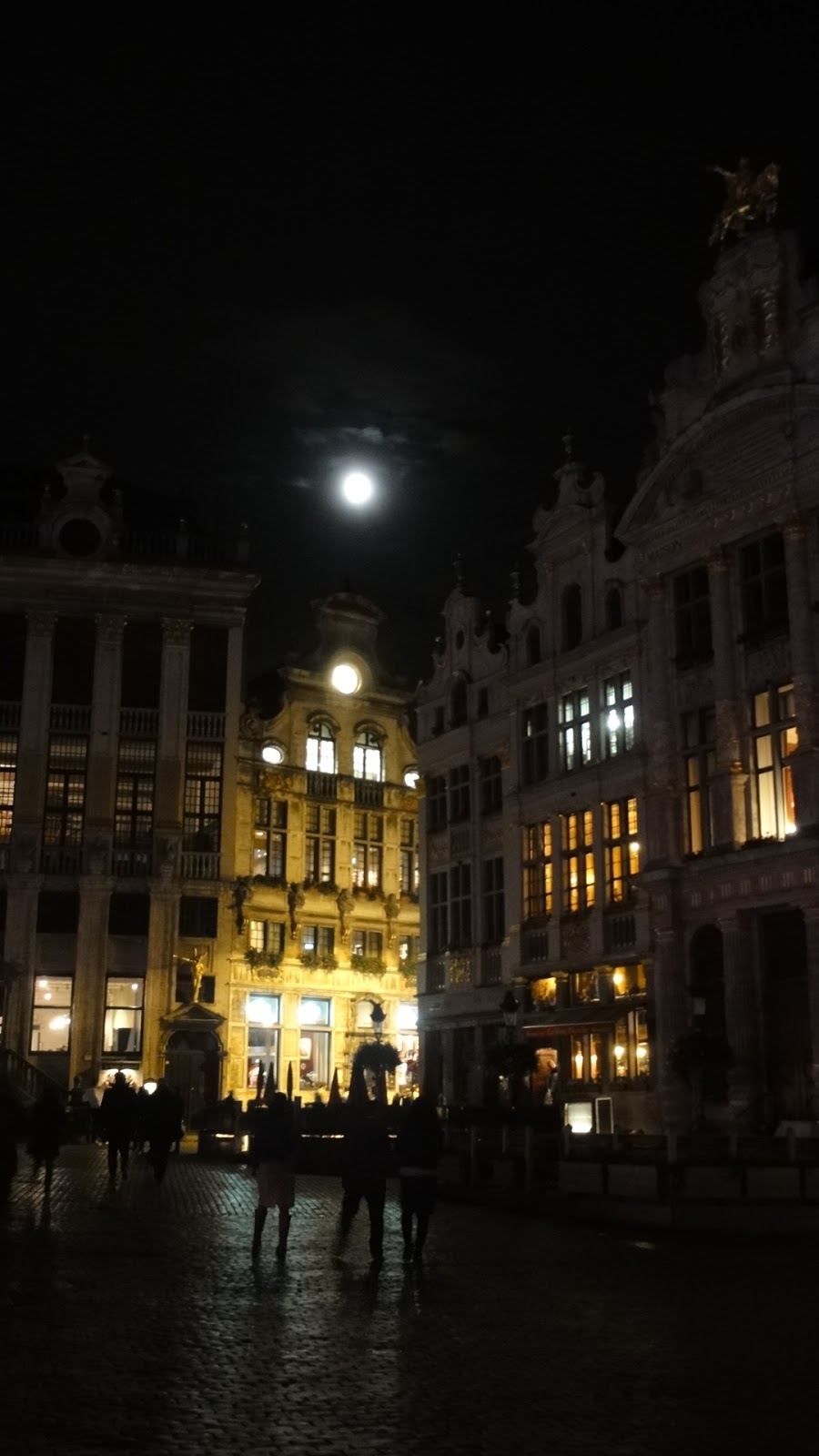
Full moon over a guild house facade in the Grote Markt, Brussels.

 This time around I ended up visiting Brussels twice—the first night of my stay with Bahar and again the last night, and both times Bahar left me to my own devices as she dutifully went to work in the restaurant. On my last night, I again went in search of Le Manneken Pis and found him on a corner surrounded by a large group of tourists, even including a guided tour, taking pictures. I literally couldn’t help but laugh at all of us, all of us come to find this point of interest.

There he is! Surrounded by tourists!

Kelci and the peeing boy. Can you tell by the look on my face I am suppressing a laugh on this absurdity?

Bahar in front of a Burssels candy shop. Too bad it was closed because Bahar loves candy shops!

 Neither time I visited Brussels with Bahar could I get a grip on the city—I wasn’t bothered by the French yet the city was strangely international in a way I couldn’t put my finger on. It seemed overwhelmingly young, like teenagers were particularly fond of partying on its literally red carpeted streets, and Bahar and I managed to meet two business women and their boss from Norway (that had been kicked out of a strip club earlier), a guy that kept spitting on us (on accident) from Chile (who proclaimed to be the owner of the Irish pub we were sitting in front of), and two Romanians (one of which was running a Greek restaurant and the other of which offered us the Presidential Suite at the Sheraton). Only in Brussels was I bothered persistently for cigarettes, and only in Brussels did young Moroccan boys get in our face and hassle us to share our frits with them. (Although these things are irritating, they don’t hold a candle to the way San Francisco crazies can disturb you.) 

Chowing down on ribs at the Antwerp location of the restaurant Bahar works in.
Riding one of Bahar's bikes through the center of Antwerp, with the Cathedral of our Lady rising into the black sky behind me.


Of course Bahar and I spent a lot of time in Antwerp, good old Antwerp with its medieval winding alleys, cobblestone streets, guild house facades, and ornate cathedral. Bahar loves Antwerp and feels quite proud of her city—she thinks it's the perfect size, not too big and not too small, and it's easy to agree with her opinion that's it's beautiful. We hung out with her friends, went to the movies, partook in Belgian specialties like waffles and frits, ate at restaurants, and frequented cafes to sample the many wonderful beers Belgium has to offer. Bahar loves sweet beers so we attempted to try as many new sweet beers—the stronger the better—as we could find. Sometimes we would go to cute or unique cafes and sometimes places specifically for their beer selection, like Bier Central near Centraal Station. 

Waffles!!

Partying down in Molly's Irish Pub in Antwerp.

 One particular night in Ghent, after an afternoon spent at the sea in Blankenberge, we started out with some usual choices, Kriek and La Chouffe, then progressed to more adventurous choices: I ordered Bière De Miel Biologique—an organic honey beer—and Bahar ordered Geuze Mariage Parfait—the perfect marriage. When the server brought the beers, she gave me Bahar’s and vice versa. One sip of Bahar’s beer brought a scowl to my face; an uncanny yeasty bitterness enveloped my mouth. I almost said out loud, “Do I have to drink this?” but then Bahar realized the switcheroo. If I couldn’t stand the hyper-fermented yogurt taste of the beer, how was Bahar’s sweet palette going to handle it? Somehow, she managed, she really suffered through it. What a champ! Later her efforts were rewarded by an extremely drunk Belgian leaning on the table to talk to her and the table flipping over, spilling her fresh beer all over her front. We took it as a sign—I got a to-go cup for my remaining beer (yes, those exist at bars in Belgium!) and we made our exit over the canal and out of the city center. 

The Dreupelkot/Beer House in Ghent had a funny menu. "This is rather difficult to explain: Frenchmen say that foreigners are crazy; Holland people pretend to know best; and the Germans are always talking about their Reinheitsgebot, a 500 years old law concerning the prime materials used to produce beer. They are right for these beers,..."


Our adventurous picks: Bière De Miel Biologique and Geuze Mariage Parfait. This was obviously before the drunk dude flipped the table over.

Despite how disgusting Mariage Parfait was, Bahar finished it! Look at her empty glass!

 My third night in Belgium was another special one. Since Bahar had to work, I went with her brother Mehmet to a party for the Erasmus international students at UA (Universiteit Antwerpen), where everyone was supposed to bring a food dish from their country. I appeared to be the only U.S. contingent and had acquired a few boxes of chocolate chip cookies with the Statue of Liberty on the package and a jar of peanut butter with an American flag stretched across the label—American style! it proclaimed. I instructed the confused students to slather the peanut butter on the cookies; the few that did seemed to enjoy it and Mehmet agreed it was a hit. As the night wore on I kept feeling secretly superior to everyone there: I was here having a great time and I didn’t even have to be a student to do it! The truth would come out as I got to talking to someone new—and there were a lot of conversations that night—that I wasn’t actually a student at the University, yet I had a great time meeting all the people from different counties at the beginning of their semester in Belgium. After we left the party in the University building, we loitered in one of the squares drinking and smoking for a long time, went to a dance club in the red light district with a couple Polish girls we had acquired along the way, and then Mehmet took me to meet Bahar at a nearby pub where she was having a drink with a coworker. Bahar, her coworker, and I ate doner kebab at a place run by goofy Turkish dudes then we were chased down the street by drunken Belgian students who were trying to throw a bicycle inner tube around our heads. All in a night in Antwerp! 

Mehmet brought this Turkish dessert that sort of tasted like cotton candy but looked like strands of hair. Towards the end of the dinner we started up conversations with groups of people based on the premise they had to try this sweetness. The wasted girls on the left thought the candy made good mustaches.

The Polish girls we acquired made some interesting shots called Mad Dogs. I was a big fan so I got the recipe: most of the shot glass filled with vodka, slowly pour a berry liqueur into the top, and a few dashes of Tabasco. LEKKER!

Yours truly flanked by the Polish girls on some abandoned furniture outside University housing.

The streets of the center of Antwerp are overtaken on Thursdays because it's students' night!

 Bahar was the perfect host; she embodies Turkish hospitality in a completely overwhelming way to me. We went out almost every day, riding our bikes to the center, or taking the train to the sea, or driving to Brussels, and when she had to work she installed me with one of her family members. So many times we would discuss plans to do separate things since she, you know, had a life to attend to, and each time she would end up coming with me, chaperoning us on another exciting adventure in Belgium. In a very perfect way, she was the ideal landing pad for me; I almost can’t fathom how I would have made the well-fed transition from boat-dweller to European city dweller without Bahar and her warm family.

The one night we stayed home, after I got my hair done at her cousin's fabulous hair salon in Hoboken.

 A couple points of interest in Antwerp are the new MAS museum and the Flemish House of Literature (Letterenhuis). I wasn't able to view the collections of the former but I made it up to the observation terrace on the top floor just in time for a stunning rainbow that stretched across all of Antwerp. It was amazing! The trip to the MAS was worth that alone. As for the latter, the Letterenhuis, I can recommend it to anyone who is interested in/has studied literature and writing or anyone who is interested in the book as an object. The staff dutifully informed me none of the exhibits were in English, but I opted to have a look anyway. I was not disappointed! On the main floor, an exhaustive timeline of keypoints in Flemish literature kept pace with literary developments around the world, and many display cases held unique manuscripts and first editions by Flemish authors, usually surrounded by other ephemera from the same period.

The new MAS.

Beautiful rainbow viewed from the roof of the MAS.

This picture may suggest I am the pot of gold at the end of the rainbow.

This text was on the wall in the women's bathroom of the Letterenhuis. Rough translation: "Life is not a book. The beginning is nowhere. It is here and there and yonder, and everything happens at once. A book is different." Louis Paul Boon, Abel Gholaerts (1944)


Bahar and I enjoying the Belgian coast.

Sunset over Blankenberge.

Cargo ships making their way through the North Sea--that was me a week ago!

Last bits of orange peeking through the clouds.

Enjoying the sunset with a bottle of liebfraumilch.

 My favorite day was the afternoon we spent in Blankenberge, which is a town on the coast of the North Sea in West Flanders. Once we came to the beach, after walking down the shopping street from the train station, something in me clicked: days before I had sailed past this town on the ship. I recognized the sea and the clouds; I saw the cargo liners moving through their routes close to the horizon. To the right was even a small port with cargo cranes standing at the ready. Although I was in a transition period, I felt serene on the sand before the water. It reminded me of San Francisco’s Ocean Beach, the day I swam at Coney Island in New York with Cricket before I flew to Argentina, and the many waters the ship had sailed through. But now, almost three months after I had left home, I was standing on the coast of the North Sea, mere kilometers from my end goal: Amsterdam. My future and my past met each other here on the Belgian sand; one of my feet was in the sea and the other was taking the step towards Holland.